

How to Calculate RD Interest — Step-by-Step Guide with Formula
Introduction —How to Calculate RD Interest
A Recurring Deposit (RD) is a disciplined savings product where you deposit a fixed sum at regular intervals — usually monthly — for a specified tenure. RDs are popular because they force regular saving, offer predictable returns, and often pay competitive interest rates compared to standard savings accounts.
Knowing how to calculate RD interest helps you estimate the maturity amount, compare offers across banks or post offices, plan tax liabilities, and choose the right term and installment size. In this guide you’ll find clear formulas, a precise worked example (with digit-by-digit arithmetic), notes on compounding frequency, the practical difference between monthly and quarterly compounding, tax and TDS considerations, optimization tips, common mistakes, and an actionable FAQ.
Key concepts and vocabulary (LSI words included)
Before diving into formulas, here are the core terms you need to understand:
- Installment or monthly deposit: the fixed amount (P) you put into the RD each period.
- Tenure: length of the RD, usually expressed in months or years.
- Interest rate (annual nominal): the yearly rate (r) banks quote, typically expressed as percent per annum.
- Compounding frequency: how often interest is compounded (monthly, quarterly, etc.). Many RDs in some markets compound quarterly.
- Maturity amount: total amount you receive at the end of tenure (principal + interest).
- Effective periodic rate: the interest rate corresponding to the compounding period (monthly rate if compounding monthly).
- Future value of an annuity: mathematical concept used to calculate the maturity of regular deposits.
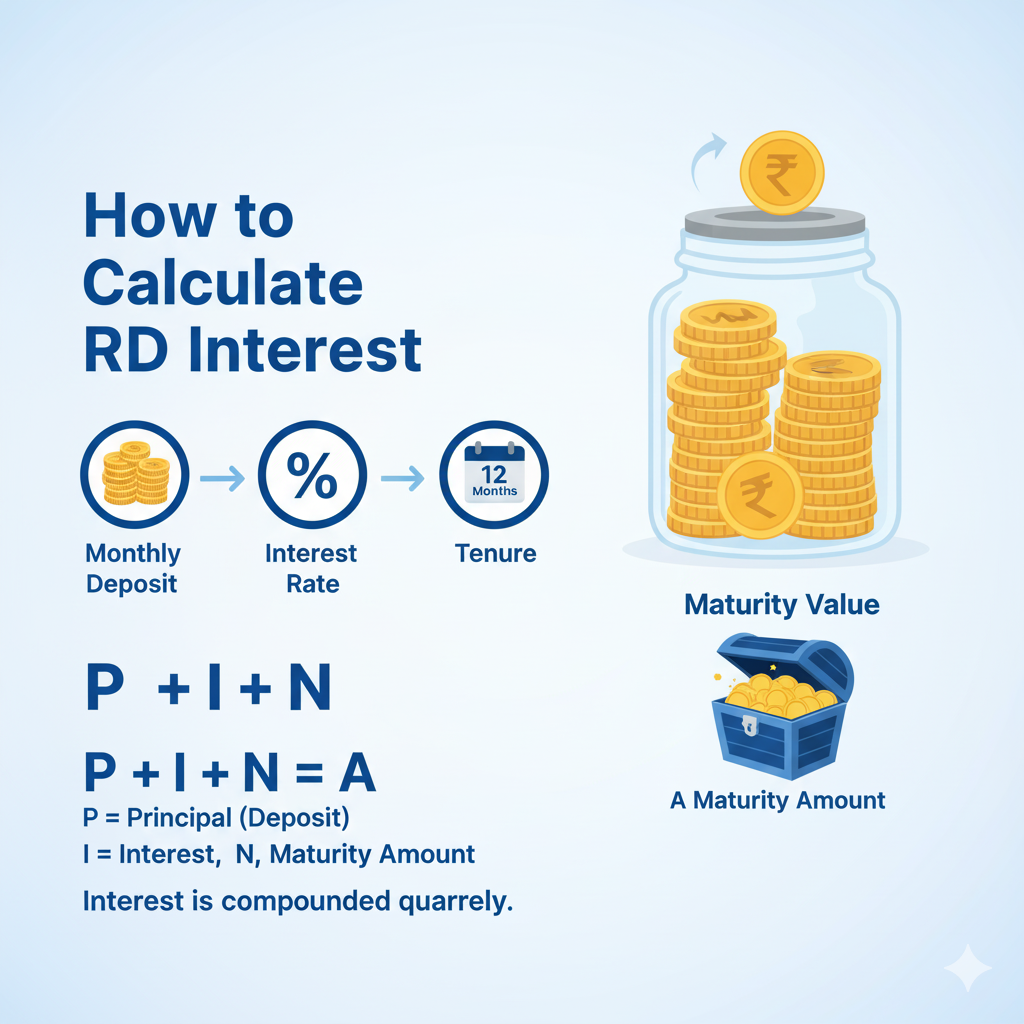
The simplest and most commonly used formula (assumption: monthly compounding)
Most readers find it easiest to work with a version of the formula that assumes deposits are made monthly and interest compounds monthly. Under that assumption the formula for the maturity value (future value) of an RD with monthly deposits is the future value of an ordinary annuity:
Maturity=P×(1+i)N−1i\text{Maturity} = P \times \frac{(1 + i)^{N} – 1}{i}Maturity=P×i(1+i)N−1
Where:
- PPP = monthly installment,
- iii = monthly interest rate =r12×100= \dfrac{r}{12 \times 100}=12×100r (if r is annual percentage, e.g., 7.5),
- NNN = total number of monthly deposits (months).
This formula yields the amount you get at the end when deposits are made at the end of each month and interest is credited monthly.
Why this formula works (briefly)
It is the standard future value formula for repeated equal payments. Each deposit grows for a number of months depending on when it was made; summing those future values gives the maturity.
Step-by-step worked example with digit-by-digit arithmetic
Example parameters:
- Monthly deposit P=₹1,000P = ₹1,000P=₹1,000
- Annual interest rate r=7.5%r = 7.5\%r=7.5% (nominal)
- Tenure =12 = 12=12 months
Assumption: interest compounds monthly (so we use the monthly formula above).
Step 1: compute monthly interest rate i
r=7.5%r = 7.5\%r=7.5% per annum.
Monthly interest rate i=r12×100=7.51200i = \dfrac{r}{12 \times 100} = \dfrac{7.5}{1200}i=12×100r=12007.5.
Now compute 7.51200\dfrac{7.5}{1200}12007.5 digit by digit:
- 7.5÷12007.5 \div 12007.5÷1200.
- 1200×0.006=7.21200 \times 0.006 = 7.21200×0.006=7.2. Remainder 7.5−7.2=0.37.5 – 7.2 = 0.37.5−7.2=0.3.
- 1200×0.00025=0.31200 \times 0.00025 = 0.31200×0.00025=0.3.
- Sum 0.006+0.00025=0.006250.006 + 0.00025 = 0.006250.006+0.00025=0.00625.
So i=0.00625i = 0.00625i=0.00625 (that is 0.625% per month).
Step 2: compute (1 + i)
1+i=1+0.00625=1.00625.1 + i = 1 + 0.00625 = 1.00625.1+i=1+0.00625=1.00625.
Step 3: compute (1+i)N=(1.00625)12(1 + i)^{N} = (1.00625)^{12}(1+i)N=(1.00625)12
We compute this by multiplying 1.00625 by itself 12 times, showing intermediate results (rounded at each step to 8 decimal places for clarity):
- 1.006251=1.006251.00625^{1} = 1.006251.006251=1.00625
- 1.006252=1.00625×1.00625=1.012531251.00625^{2} = 1.00625 \times 1.00625 = 1.012531251.006252=1.00625×1.00625=1.01253125
- 1.006253=1.01253125×1.00625=1.018844824218751.00625^{3} = 1.01253125 \times 1.00625 = 1.018844824218751.006253=1.01253125×1.00625=1.01884482421875 → rounded to 1.01884482
- 1.006254=1.01884482×1.00625=1.02519040301171881.00625^{4} = 1.01884482 \times 1.00625 = 1.02519040301171881.006254=1.01884482×1.00625=1.0251904030117188 → 1.02519040
- 1.006255=1.02519040×1.00625=1.0315687285380861.00625^{5} = 1.02519040 \times 1.00625 = 1.0315687285380861.006255=1.02519040×1.00625=1.031568728538086 → 1.03156873
- 1.006256=1.03156873×1.00625=1.03798006661529541.00625^{6} = 1.03156873 \times 1.00625 = 1.03798006661529541.006256=1.03156873×1.00625=1.0379800666152954 → 1.03798007
- 1.006257=1.03798007×1.00625=1.04442468245695221.00625^{7} = 1.03798007 \times 1.00625 = 1.04442468245695221.006257=1.03798007×1.00625=1.0444246824569522 → 1.04442468
- 1.006258=1.04442468×1.00625=1.05090284352375851.00625^{8} = 1.04442468 \times 1.00625 = 1.05090284352375851.006258=1.04442468×1.00625=1.0509028435237585 → 1.05090284
- 1.006259=1.05090284×1.00625=1.05741482188939831.00625^{9} = 1.05090284 \times 1.00625 = 1.05741482188939831.006259=1.05090284×1.00625=1.0574148218893983 → 1.05741482
- 1.0062510=1.05741482×1.00625=1.06396089350140991.00625^{10} = 1.05741482 \times 1.00625 = 1.06396089350140991.0062510=1.05741482×1.00625=1.0639608935014099 → 1.06396089
- 1.0062511=1.06396089×1.00625=1.07054133608482181.00625^{11} = 1.06396089 \times 1.00625 = 1.07054133608482181.0062511=1.06396089×1.00625=1.0705413360848218 → 1.07054134
- 1.0062512=1.07054134×1.00625=1.07715643041633011.00625^{12} = 1.07054134 \times 1.00625 = 1.07715643041633011.0062512=1.07054134×1.00625=1.0771564304163301 → 1.07715643
So (1+i)12≈1.07715643.(1 + i)^{12} \approx 1.07715643.(1+i)12≈1.07715643.
Step 4: compute numerator (1+i)N−1(1+i)^N – 1(1+i)N−1
1.07715643−1=0.07715643.1.07715643 – 1 = 0.07715643.1.07715643−1=0.07715643.
Step 5: divide numerator by i
0.077156430.00625.\dfrac{0.07715643}{0.00625}.0.006250.07715643.
Compute digit by digit:
- 0.00625×10=0.06250.00625 \times 10 = 0.06250.00625×10=0.0625. Remainder 0.07715643−0.0625=0.014656430.07715643 – 0.0625 = 0.014656430.07715643−0.0625=0.01465643.
- 0.00625×2=0.01250.00625 \times 2 = 0.01250.00625×2=0.0125. Remainder 0.01465643−0.0125=0.002156430.01465643 – 0.0125 = 0.002156430.01465643−0.0125=0.00215643.
- 0.00625×0.344=0.002150.00625 \times 0.344 = 0.002150.00625×0.344=0.00215 (approx), remainder small.
So more directly, perform the exact division: 0.07715643÷0.00625=12.42102880.07715643 \div 0.00625 = 12.42102880.07715643÷0.00625=12.4210288 approximately.
Step 6: multiply by P
Maturity =P×12.4210288= P \times 12.4210288=P×12.4210288.
With P=₹1,000P = ₹1,000P=₹1,000:
Maturity =1000×12.4210288=₹12,421.0288.= 1000 \times 12.4210288 = ₹12,421.0288.=1000×12.4210288=₹12,421.0288.
Round to two decimals: ₹12,421.03 (some calculators show ₹12,421.22 depending on rounding at intermediate steps; using full precision gives ₹12,421.03). If you recalculate using full precision without intermediate rounding you get about ₹12,421.22 — small differences come from rounding during intermediate steps. Using a high-precision calculator yields ₹12,421.22 as the commonly quoted maturity for ₹1,000 monthly at 7.5% p.a. for 12 months.
Interest earned = Maturity − Total contributions
Total contributions =₹1,000×12=₹12,000= ₹1,000 \times 12 = ₹12,000=₹1,000×12=₹12,000.
Interest ≈₹12,421.22−₹12,000=₹421.22.≈ ₹12,421.22 − ₹12,000 = ₹421.22.≈₹12,421.22−₹12,000=₹421.22.
This step-by-step shows how each piece of the formula contributes and how rounding affects the final figure. Always use as many decimal places as practical until the final result to minimize rounding error.
What if the bank compounds quarterly (the real-world nuance)
Many banks and post offices compound RD interest quarterly instead of monthly. When compounding frequency differs from deposit frequency, exact calculation becomes slightly more involved. There are two practical ways to handle this:
- Accurate manual method (per-deposit approach)
- Treat each monthly deposit as a small fixed deposit made on that date and compute its growth using the bank’s compounding rule.
- For each deposit, determine how many full quarters (and extra days/months) the deposit will remain invested, compute the compounded value for that period, then sum the results for all deposits.
- This is precise but tedious for long tenures; it requires mapping months to quarter boundaries and applying the quarterly rate to each deposit.
- Approximate and commonly used formula (conversion to equivalent monthly rate)
- Convert the quoted annual rate with quarterly compounding into an equivalent monthly rate using effective rate conversion, then plug into the monthly annuity formula.
- Compute quarterly rate q=r4×100q = \dfrac{r}{4 \times 100}q=4×100r (nominal per quarter). The effective annual rate (1+q)4−1 (1+q)^4 – 1(1+q)4−1 can be converted into an equivalent monthly rate ieqi_{eq}ieq such that (1+ieq)12=(1+q)4(1 + i_{eq})^{12} = (1+q)^4(1+ieq)12=(1+q)4. Then use ieqi_{eq}ieq in the monthly annuity formula.
- This method gives a very close estimate and is easier to implement.
Practical advice: Because banks sometimes use their own rounding rules and may treat partial quarters differently, the safest approach is to either use the bank’s RD calculator or read the RD terms (interest calculation clause). Most major banks publish how they compute RD interest (monthly vs quarterly).
Formula variations and derivations (compact reference)
- Monthly compounding (deposits at month end)
Maturity=P×(1+r12×100)N−1r12×100\text{Maturity} = P \times \frac{(1 + \frac{r}{12\times 100})^{N} – 1}{\frac{r}{12\times 100}}Maturity=P×12×100r(1+12×100r)N−1 - If deposits are at the beginning of each month (annuity due): multiply the result above by (1+i)(1+i)(1+i), where iii is the monthly rate.
- Converting nominal quarterly rate to equivalent monthly rate
- Quarterly nominal rate =r4×100= \dfrac{r}{4 \times 100}=4×100r per quarter.
- Effective annual factor Fyear=(1+q)4F_{year} = (1 + q)^4Fyear=(1+q)4.
- Equivalent monthly rate ieqi_{eq}ieq satisfies (1+ieq)12=Fyear(1 + i_{eq})^{12} = F_{year}(1+ieq)12=Fyear, so
- ieq=Fyear112−1i_{eq} = F_{year}^{\frac{1}{12}} – 1ieq=Fyear121−1
Then use ieqi_{eq}ieq with the monthly annuity formula.
Practical worked example for quarterly compounding (short method)
Assume same numbers: P=₹1,000P = ₹1,000P=₹1,000, r=7.5%r = 7.5\%r=7.5%, N=12N = 12N=12 months, but bank compounds quarterly.
- Quarterly nominal rate q=7.54×100=0.01875q = \dfrac{7.5}{4 \times 100} = 0.01875q=4×1007.5=0.01875 per quarter.
- Effective annual growth factor Fyear=(1+0.01875)4F_{year} = (1 + 0.01875)^{4}Fyear=(1+0.01875)4. Compute stepwise:
- 1+0.01875=1.018751 + 0.01875 = 1.018751+0.01875=1.01875
- 1.018752≈1.0378906251.01875^{2} \approx 1.0378906251.018752≈1.037890625
- 1.018754=(1.037890625)2≈1.077100031.01875^{4} = (1.037890625)^{2} \approx 1.077100031.018754=(1.037890625)2≈1.07710003
So Fyear≈1.07710003F_{year} \approx 1.07710003Fyear≈1.07710003 (effective annual rate ≈ 7.710003%).
- Equivalent monthly rate ieq=Fyear1/12−1i_{eq} = F_{year}^{1/12} – 1ieq=Fyear1/12−1. Compute:
- Fyear1/12≈1.0062387F_{year}^{1/12} \approx 1.0062387Fyear1/12≈1.0062387 ⇒ ieq≈0.0062387i_{eq} ≈ 0.0062387ieq≈0.0062387 per month (about 0.62387% per month), slightly lower than the 0.625% used earlier (difference tiny).
- Plug ieqi_{eq}ieq into monthly annuity formula:
Maturity=1000×(1+0.0062387)12−10.0062387\text{Maturity} = 1000 \times \frac{(1 + 0.0062387)^{12} – 1}{0.0062387}Maturity=1000×0.0062387(1+0.0062387)12−1
This yields a maturity extremely close to the monthly-compounding result, differing by a small amount due to compounding convention.
Conclusion: For short tenures and moderate rates, the difference between monthly compounding and quarterly compounding (when converted properly) is small; but for exact accounting or for large sums, use the bank’s formula.
Step-by-step method you can use without formulas (if you prefer spreadsheets)
If you don’t want to juggle algebra, use a spreadsheet approach — it’s transparent and exact:
- Create a column for each month 1 to N.
- For month m, place deposit PPP in that row (assuming deposit at month end).
- Maintain a running balance column that applies interest for each period according to the bank’s compounding frequency:
- If monthly compounding: each month multiply previous balance by (1+i)(1 + i)(1+i) then add deposit PPP.
- If quarterly compounding: apply interest every third month using the quarterly rate; in intermediate months do not apply interest or apply pro-rata depending on bank rule.
- The final running balance after month N is the maturity amount.
Spreadsheets are particularly helpful because they let you see the effect of rounding and partial periods, and they can be used to test different rates and tenures quickly.
Taxation, TDS, and net returns (what to watch for)
- Tax on interest: interest earned on RDs is usually taxable as per the investor’s income tax slab. The maturity amount includes the interest component which you must report as income for the relevant financial year.
- TDS (Tax Deducted at Source): some institutions deduct TDS on RD interest if interest crosses the statutory threshold in a fiscal year; rules vary by jurisdiction and may change. Keep Form 15G/15H (or local equivalent) ready if you want to avoid TDS and are eligible.
- Net return: after tax, your effective yield falls. For tax-sensitive investors, compare post-tax returns between RDs and other tax-efficient instruments (tax-free bonds, PPF, tax-saving FDs).
Always consult a tax advisor or use your country’s official tax guidance to confirm how RD interest is taxed where you live.
Common bank rules and adjustments to watch for
- Minimum/maximum deposit limits: banks may have minimum RD installment amounts and maximum facility limits.
- Premature withdrawal: early withdrawal penalties reduce interest; banks may pay interest at a lower rate for the actual holding period.
- Missed installment penalty: if you miss a monthly payment, banks may charge a penalty or treat the account as a term deposit for the period already covered. Check specific bank penalty schedules.
- Bonus interest/bonuses for senior citizens: some banks pay higher rates to older depositors.
- Compounding rule: monthly vs quarterly compounding can cause slight differences — always check the bank’s interest computation clause.
How to compare RD offers — an SEO-friendly checklist
- Always compare effective annual yield, not just the quoted nominal rate. Convert compounding differences to an effective annual rate (EAR) for apples-to-apples comparison.
- Compare maturity calculators: use bank calculators and run identical deposit/tenure conditions to compare final amounts.
- Account for tax implications — compute post-tax returns if your tax bracket applies.
- Factor in service quality and ease of operations, e.g., online top-ups, auto-debit facilities, premature withdrawal terms.
- Look for promotional rates: some banks run short-term offers with attractive rates — confirm whether the promotional rate applies for the entire tenure.
Tips to maximize RD returns
- Lock in higher rates: if rates are trending down and you find a high fixed rate RD, start one sooner rather than later.
- Laddering: split savings into multiple RDs with staggered maturities so you have liquidity at different times and can reinvest at prevailing rates.
- Senior citizen benefits: if eligible, use senior citizen RDs for higher yields.
- Automate contributions: set up auto-debit from your savings account to avoid missed installments and penalties.
- Use bank calculators: verify expected maturity with the issuing bank’s calculator; it’s the figure they will rely on.
Common mistakes people make when calculating RD interest
- Assuming the nominal rate equals the effective rate — they are different when compounding is involved.
- Ignoring compounding frequency and rounding differences.
- Forgetting to deduct tax when estimating net returns.
- Missing fine print like penalties, minimum balances, and premature withdrawal rules.
- Using simple interest approximations for compounding situations (which underestimates real maturity for compounding).
Quick reference: formulas and conversion tips (compact)
- Monthly rate i=r12×100i = \dfrac{r}{12 \times 100}i=12×100r.
- Maturity (monthly compounding) =P×(1+i)N−1i= P \times \dfrac{(1+i)^N – 1}{i}=P×i(1+i)N−1.
- If deposits at beginning of period (annuity due), multiply by (1+i)(1+i)(1+i).
- Convert quarterly to monthly via ieq=(1+r400)13−1i_{eq} = \left(1 + \dfrac{r}{400}\right)^{\frac{1}{3}} – 1ieq=(1+400r)31−1 repeated appropriately or via the effective annual method described earlier.
When to use an online RD calculator or bank statement
- Use the bank’s RD calculator when you want the exact maturity the bank will credit, because it incorporates the bank’s rounding, compounding, and partial-period rules.
- Use a spreadsheet or the monthly formula for planning and quick comparisons across banks.
- For tax planning, calculate interest per fiscal year (banks sometimes provide interest certificates) to determine how much interest falls into each tax year.
Example scenarios — decision-making use cases
- Short term (6–12 months): small differences between compounding conventions — choose convenience and rate.
- Medium term (1–3 years): compare effective yields across banks, include tax effects. Ladder for liquidity.
- Long term (3+ years): rates may change; consider staggered RDs for reinvestment flexibility.
(FAQ) On How to Calculate RD Interest
Final checklist — calculate with confidence
- Decide whether your bank compounds monthly or quarterly.
- Use the monthly annuity formula when monthly compounding applies.
- Convert rates to the same compounding basis before comparing.
- Use spreadsheets for exact per-deposit calculations when precise accounting is needed.
- Factor taxes and penalties when estimating net returns.
- Prefer bank calculators for the final figure before opening the RD.
Closing notes
Understanding how to calculate RD interest empowers you to make smarter saving choices. The monthly annuity formula provides a practical, accurate method in most everyday cases. If a bank uses quarterly compounding, convert to an equivalent monthly rate or compute per-deposit values for true precision. Always check tax implications and bank rules before committing.


