
RD Calculator
Calculate your Recurring Deposit maturity amount
Recurring deposits remain one of the most accessible, disciplined, and risk-averse ways to build savings over time. Whether you are saving for a short-term goal or building a steady corpus for the future, understanding how returns accumulate and how to plan is crucial. An RD calculator — often called an online RD calculator or recurring deposit calculator — removes the guesswork and helps you forecast maturity value, interest earned, and monthly commitment. This long-form guide explains everything: what an RD calculator is, how recurring deposits work, the math behind them, how to use an online RD calculator effectively, tax implications, practical examples and strategies, common mistakes to avoid, and an FAQ to answer typical concerns.
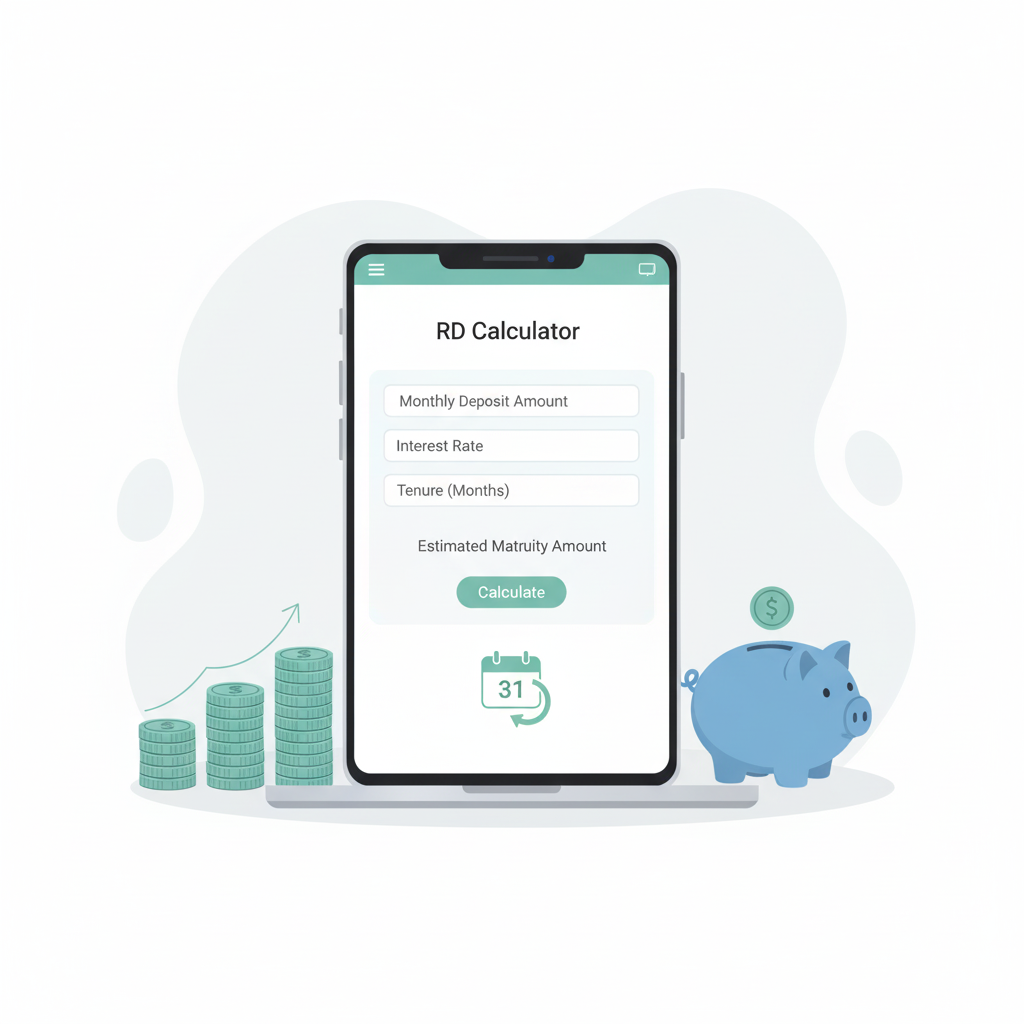
What is an RD (Recurring Deposit)?
A recurring deposit is a financial product typically offered by banks and post offices where an individual deposits a fixed amount every month for a predetermined tenure. Unlike a lump-sum deposit, where you invest a single sum at the start, an RD requires periodic deposits (usually monthly). In return, the institution pays you interest on the accumulating balance, with interest frequently compounded quarterly or monthly depending on the issuer’s policy.
The RD stands out for disciplined savings: by mandating monthly deposits, it encourages regular contributions and reduces the temptation to spend. This makes it ideal for salaried professionals, students, and anyone looking to build a predictable savings corpus without assuming market risk.
Why Use an RD Calculator?
Before you commit to monthly deposits for a defined period, it’s valuable to know the outcome: how much will you get at maturity? That’s where an RD calculator becomes indispensable. An online tool lets you:
- Estimate the maturity value for different monthly contributions and tenures.
- Compare returns for varying interest rates.
- Understand the total interest earned over the life of the RD.
- Plan and set realistic monthly savings targets to meet specific financial goals.
An online RD calculator removes manual math, which can be error-prone, and offers immediate scenario analysis. You can quickly test “what-if” cases — for example, what happens if you increase monthly deposits by 10% or extend the tenure by six months.
How Recurring Deposits Work — a clear explanation
In a recurring deposit, you commit to depositing an identical amount every month. The financial institution credits interest on these deposits, often compounding periodically. Compounding means interest is calculated on both the principal and previously earned interest, so your returns grow faster than simple interest. Each monthly deposit earns interest for a different duration: the first deposit in the series earns interest for the entire tenure minus one month, the last deposit earns interest for just that final month, and so on. The RD’s maturity value is the sum of all deposits plus total interest earned across the schedule.
Because each installment has a different time horizon, the aggregate interest can be calculated using a formula that accounts for periodic contributions and compounding. Doing this calculation manually is cumbersome, especially when rates and compounding frequencies vary. That is why the RD calculator is so helpful — it automates the math and provides instant clarity.
The formula behind RD calculators (simple view, no heavy algebra)
Most RD calculators use a formula that treats each monthly deposit as an individual investment growing at the applicable rate of interest. A commonly used simplified approach for monthly installments with interest compounded quarterly is to convert the annual nominal rate into its effective periodic rate and then sum the future values of each installment.
Even though different institutions may use slightly different compounding conventions or rounding rules, the underlying idea is constant: calculate the future value of each monthly deposit and add them up. The online calculator performs these repetitive computations correctly and quickly, which is why it’s preferred to manual calculation.
Key terms you should know
Understanding some recurring deposit vocabulary will help you use an online RD calculator more effectively:
- Principal (Monthly Installment): The amount you deposit each month.
- Tenure: The length of time you commit to deposit monthly (commonly expressed in months or years).
- Interest Rate (Nominal Annual Rate): The percentage annual return offered by the bank or post office.
- Compounding Frequency: How often the interest is added to the principal (monthly, quarterly, annually).
- Maturity Value: The total amount you get at the end of the tenure — principal plus interest.
- Effective Interest: The true interest after compounding is taken into account.
- Premature Withdrawal / Breakage: Early closure penalties may reduce the rate applicable to your RD.
Knowing these words makes it easier to interpret calculator outputs and plan financial decisions accordingly.
Benefits of using an online RD calculator
An online RD calculator offers several advantages over manual planning:
- Speed and accuracy: Instantly compute maturity value and interest with no math errors.
- Scenario planning: Try multiple combinations of monthly deposit, tenure, and interest rate to find the best fit for your goals.
- Comparison shopping: Use the calculator to compare offers from different banks or product variants.
- Goal alignment: Work backward from a target corpus to determine the required monthly contribution.
- Transparency: The calculator shows interest earned separately from total deposits, so you see how much growth the deposits generate.
These benefits make the online RD calculator one of the easiest productivity tools for personal finance planning.
RD vs FD vs SIP — where does RD fit?
To choose the right instrument, you must compare recurring deposits with other popular savings and investment options:
- Recurring Deposit (RD): Regular fixed monthly deposits; guaranteed returns; low risk; best for disciplined savers with monthly cash flow.
- Fixed Deposit (FD): Lump-sum deposit upfront; fixed interest rate; typically higher minimum investment; preferred for one-time surplus funds.
- Systematic Investment Plan (SIP): Investments in mutual funds typically via monthly contributions; returns are market-linked and can be higher over long periods but come with market risk.
Use an RD calculator if you want fixed, guaranteed returns with a predictable monthly habit. If you have a lump sum and prefer higher returns without monthly contributions, compare FDs. If you’re comfortable with market risk and seek potentially higher returns, compare SIP projections instead.
How to use an online RD calculator — a step-by-step approach
Using an online RD calculator is straightforward, but to extract the most value, follow a simple method:
First, define the goal. Are you building an emergency fund, saving for a wedding, or accumulating a down payment?
Second, choose your tentative tenure and monthly installment. If you have a target sum, use the calculator’s reverse mode (if available) to compute the monthly deposit required to reach that corpus.
Third, enter the interest rate. Use the prevailing rate offered by your selected bank or post office. If you’re not sure, try a conservative estimate and a slightly higher estimate to see the range of outcomes.
Fourth, select the compounding frequency (if the calculator allows). Many retail RD products compound quarterly, but it varies. If the exact policy isn’t provided, use quarterly or monthly depending on the provider.
Fifth, review the output: maturity value, total principal invested, and total interest earned. Check whether the maturity matches your financial schedule.
Finally, run alternative scenarios: extend or shorten the tenure, increase or decrease monthly contributions, and observe how the maturity value changes. This will help you tune your plan.
Practical example — using numbers to illuminate
Imagine you want to save for a home furnishing project and expect to contribute monthly. You consider depositing Rs 5,000 per month for 3 years at a nominal annual rate of 6.5% compounded quarterly. An online RD calculator will quickly show:
- Total principal invested = 5,000 × 36 = Rs 180,000.
- Interest earned (estimated) = depends on compounding; the RD calculator will compute the precise number.
- Maturity value = Rs 180,000 + interest.
With an online tool you can also test alternate choices: what if you extend the tenure to 4 years? What if you increase monthly deposit to Rs 6,000? These variations reveal the leverage of small incremental increases in monthly contributions or tenure on the final corpus.
Tax treatment and RD calculators — what you must keep in mind
Interest from recurring deposits is taxable as per your income tax slab in many jurisdictions. The RD calculator typically presents the gross maturity value and interest before tax. For accurate net returns, adjust for applicable taxes:
- Interest earned each year is added to your taxable income and taxed accordingly.
- Some banks may deduct Tax Deducted at Source (TDS) on interest above a threshold, depending on local tax rules; you need to factor this into your net yield.
- If you’re in a tax-advantaged account or have exemptions, check whether RD interest qualifies for any relief.
An online RD calculator that includes a “tax adjusted” mode or a field for your tax rate will provide a better estimate of post-tax maturity. If such a feature is not available, you can subtract estimated tax from the total interest to estimate post-tax proceeds.
Choosing the right RD product — how the calculator helps
Different banks and financial institutions offer varying interest rates, compounding frequencies, and features like nominee addition, premature withdrawal terms, and auto-renewal. The online RD calculator helps you compare apples to apples by enabling quick scenario analysis:
- Input the monthly deposit and tenure, then try different interest rates offered by multiple banks to see which one yields better maturity.
- Account for compounding differences. A higher nominal rate with less frequent compounding might be less profitable than a slightly lower nominal rate that compounds monthly.
- Use the calculator to determine whether the difference in maturity justifies switching to another provider, given the paperwork and any costs involved.
By making comparisons, you can confidently pick a product that aligns with your goals and optimizes yield.
Common mistakes people make without a calculator
Many savers misjudge returns because human intuition struggles with compounding on staggered contributions. Common mistakes include:
- Underestimating the time value of money: people often assume each deposit has the same horizon as the first or the last.
- Ignoring compounding differences: nominal rates can be misleading if compounding frequency differs.
- Forgetting taxes: assuming the gross maturity is the same as take-home maturity.
- Skipping scenario planning: not checking what happens if interest rates change or if you miss a deposit.
An online RD calculator prevents these mistakes by showing clear, numeric outcomes and enabling side-by-side comparisons.
When to prefer an RD over other instruments
Recurring deposits suit a particular profile:
- You prefer predictable, guaranteed returns.
- You need a disciplined monthly savings vehicle.
- You are risk-averse and want to avoid market volatility.
- You have a medium-term goal (often 6 months to 5 years).
- You want to stagger contributions but still earn compounded interest.
If these match your situation, an RD — and an RD calculator to plan it — is a logical choice.
Advanced use: backward planning with an RD calculator
Sometimes your objective is to reach a fixed target by a future date. Many RD calculators have a “goal seeker” or “reverse calculation” mode that lets you input the target maturity and the tenure and returns the monthly contribution required. This backward planning is often more useful than forward calculation because it transforms goals into actionable monthly deposits and helps you decide whether the goal is realistic given the timeline and rates.
If your current cash flow cannot support the required monthly deposit, consider either extending the tenure, lowering the target amount, or choosing an alternate instrument like a SIP that can potentially offer higher returns over longer horizons.
Scenario variations to test with an online RD calculator
To make the most of an RD calculator, test these practical scenarios:
- Increase monthly deposit by a modest percentage and observe the change in maturity.
- Extend tenure by defined increments (3 months, 6 months, 1 year) and evaluate sensitivity.
- Simulate a rate change by checking both conservative and optimistic interest rates.
- Calculate the impact of missing one or two monthly deposits and how to adjust in subsequent months to recover.
These exercises help you understand the flexibility and resilience of your plan and avoid surprises.
Choosing a trustworthy online RD calculator
Not all calculators are created equal. A good online RD calculator should:
- Allow input of monthly installment, tenure, and interest rate.
- Provide a clear breakdown: principal, interest, and maturity.
- Support different compounding frequencies or include a note on the assumption used.
- Offer a reverse calculation (target → monthly deposit) if possible.
- Avoid hidden fees and present results in easy-to-understand currency terms.
Tools on official bank websites and reputable financial portals generally offer accurate results. For maximum accuracy, match the calculator input to your product’s exact compounding rules.
Practical tips to maximize RD returns
While an RD provides fixed returns, you can still optimize:
- Shop around for the best rate, as small rate differences compound to meaningful returns over time.
- Choose longer tenures only when it aligns with goals; compounding benefits longer tenures, but liquidity needs must be considered.
- Avoid premature withdrawal to preserve higher interest rate benefits; review breakage terms carefully.
- Use auto-debit from salary accounts to ensure deposits are made on time and avoid missed installments.
- If you expect higher disposable income later, pick an RD with a tenor that allows you to increase monthly deposits or start a fresh RD to complement the existing one.
Applied consistently, these steps can increase your effective yield and help meet your objectives with predictable discipline.
Real life examples and comparative calculations
To illustrate the power of compounding and the convenience of an RD calculator, consider these two hypothetical savers:
Saver A: Deposits Rs 2,500 monthly for 2 years at a rate of 7% p.a. compounded quarterly. Saver A wants to see the maturity value and how much interest is earned.
Saver B: Targets a corpus of Rs 200,000 in 3 years and wants to know the monthly deposit required if the bank offers 6.5% p.a.
An online RD calculator will give accurate figures in seconds, whereas manual calculations would be time-consuming and error-prone. The calculators show not only the maturity but the distribution of principal vs interest, which helps both savers understand how their money is working.
What to watch for in terms and conditions
Before opening an RD, read the small print:
- Confirm compounding frequency (monthly or quarterly) and the bank’s rounding policy.
- Understand penalty rates for missed or delayed deposits.
- Check rules related to premature closure and breakage charges — often the interest rate may be reduced to the prevailing rate applicable for the actual period or a penalty may be levied.
- See whether the RD allows nominations and auto-renewal on maturity.
- Verify the TDS (tax deducted at source) policy, if any.
Clarifying these details can prevent unpleasant surprises later and ensure the RD behaves as the calculator predicted.
Integrating RD with a broader financial plan
Recurring deposits are best used as part of a diversified financial strategy:
- Use RDs for short- to medium-term guaranteed goals.
- Pair RDs with FDs for lump-sum money parked for mediumterm objectives.
- Consider SIPs or equity investments for long-term wealth creation where risk tolerance allows.
- Keep a liquid emergency fund in a savings account or liquid fund; RDs typically penalize early withdrawal so they’re less ideal for sudden liquidity needs.
An online RD calculator helps you slot RDs into broader plans by showing exact maturity values and timelines.
Common myths about recurring deposits
There are many misconceptions that stop people from using RDs effectively:
- Myth: RD returns are negligible. Reality: For risk-averse savers, RD returns are a predictable and inflation-moderated growth tool; small rate differences and compounding yield material benefits over time.
- Myth: All RDs are the same. Reality: Interest rates, compounding frequency, and breakage policies differ across providers.
- Myth: You can’t change the monthly deposit. Reality: Some banks allow modification or opening additional RDs; check the product features.
Using an RD calculator helps bust these myths by showing precise outcomes rather than vague assumptions.
Frequently Asked Questions
Checklist before you open an RD
Before finalizing, make sure to:
- Confirm the exact interest rate and compounding frequency.
- Verify the minimum and maximum tenure allowed.
- Read early closure and penalty rules.
- Check taxability and TDS implications.
- Use an RD calculator to confirm that the maturity meets your goal.
This short pre-opening review will protect you from unwelcome surprises.
Final thoughts — using an RD calculator to build a confident plan
An RD calculator and its online variants are practical, accessible tools that save time and reduce errors. They empower you to plan systematically, tailor monthly commitments to real goals, and compare competing offers with numerical clarity. For disciplined savers who prioritize capital preservation and predictable outcomes, recurring deposits are a compelling choice — and the online RD calculator is the ideal companion in planning and execution.
Use the calculator to run multiple scenarios, factor in taxes, and align deposits with cash flow. That way, you’ll transform general financial intentions into a specific, measurable plan with timelines and outcomes.