
Union Bank RD Calculator
Calculate your Recurring Deposit returns
Enter the amount you plan to deposit every month
Current Union Bank RD rate is around 6.5% per annum
Select the duration of your RD
Calculation Breakdown
This calculator provides estimates only. Actual returns may vary based on Union Bank’s current rates and terms.
A recurring deposit (RD) is one of the simplest, safest ways to build disciplined savings by setting aside a fixed amount every month and letting compound interest do the rest. If you bank with Union Bank (Union Bank of India) or are considering opening an RD there, the Union Bank RD calculator is the tool that turns guesswork into certainty. This guide explains how the calculator works, what inputs matter, how to interpret results, and practical strategies to get the most from your recurring deposit — all written to be SEO-friendly and actionable.
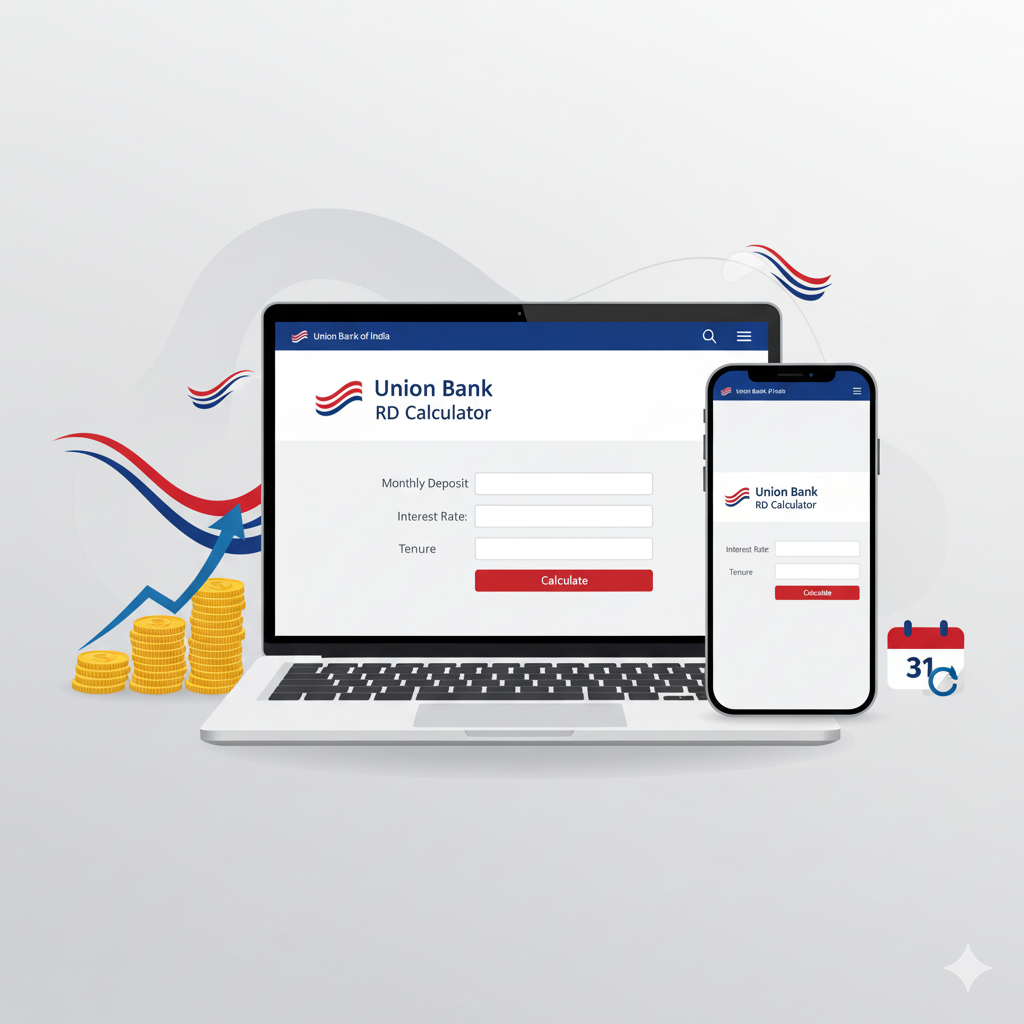
What the Union Bank RD calculator does for you
A Union Bank RD calculator forecasts how much your recurring monthly deposits will grow to at maturity. It accepts a few simple inputs — monthly installment, tenure, and the applicable interest rate — and returns the maturity amount and total interest earned. Because recurring deposit interest is typically compounded periodically (commonly quarterly for many Indian banks), the calculator applies compound interest math behind the scenes to produce an accurate result. Using a calculator saves time, prevents manual errors, and helps you compare different saving scenarios quickly. Groww+1
Why use an RD calculator instead of manual math
Recurring deposits combine regular contributions and compound interest; working out the mature sum by hand is possible but tedious and error-prone. The calculator eliminates those hassles:
- It applies the correct compounding frequency, which matters because compounding increases returns compared with simple interest.
- It lets you run multiple scenarios quickly — change the monthly amount, bump the tenure, or test different rates to see which plan meets your goals.
- It reveals the total interest earned separately from principal, clarifying the benefit of time and consistent investing.
Because interest rates and compounding details vary across banks and tenures, online RD calculators tailored to a specific bank — such as a Union Bank RD calculator — reflect the actual rate schedules that matter to your plan. Urban Money+1
Core inputs the Union Bank RD calculator asks for
When you open a Union Bank RD calculator page, you will typically be asked for three core pieces of information:
- Monthly deposit — the fixed amount you plan to invest each month.
- Tenure — duration of the RD in months or years.
- Interest rate — the nominal annual rate applicable to the tenure and your customer category (e.g., regular or senior citizen).
Some calculators also let you select the compounding frequency, the start date of the deposit, or opt for an auto-renew feature in the simulation. Entering accurate values is essential because the maturity value is sensitive to both rate and tenure. ClearTax+1
How the calculator computes maturity — plain explanation
The calculator treats each monthly contribution as a series of future values that are compounded for the remaining term. In plain language: the deposit you make in the first month compounds for the full tenure, the next month’s deposit compounds for one month less, and so on, until the last deposit compounds for the shortest period. The calculator sums the compounded value of each installment to give the final maturity amount. Because most Indian banks compound RD interest quarterly, the calculation aligns deposits and compounding intervals to reflect that reality, delivering an accurate estimate of the maturity proceeds. Groww+1
Typical Union Bank RD interest rate ranges — what to expect
Union Bank’s recurring deposit rates vary by tenure and depositor category. As with most banks, shorter tenures carry lower rates while multi-year deposits earn higher rates. Recent industry summaries and RD rate trackers show Union Bank RD rates moving within typical retail ranges and sometimes offering slightly higher rates for senior citizens. Use the bank’s published rate card or a reliable rate aggregator before finalising your choice because rates change over time. For planning, assume mid-single-digit annual rates for short tenures and slightly higher percentages for longer terms, and always verify the current rates on Union Bank’s official rate sheet or a trusted aggregator before committing. Groww+1
Step-by-step example: Using the Union Bank RD calculator
Imagine you plan to deposit ₹2,000 every month for five years and want to estimate maturity.
- Enter ₹2,000 as the monthly fixed deposit.
- Set the tenure to 5 years (or 60 months).
- Input the applicable interest rate for the 5-year RD from Union Bank’s rate sheet.
- Click calculate.
The calculator will display the maturity amount and the total interest earned over the tenure. Because the interest compounds quarterly (if that is the bank’s compounding policy), the result reflects that compounding. Try varying the monthly amount or tenure to see how small changes in discipline grow into meaningful sums over time. Angel One+1
Interpreting the output: maturity amount vs interest earned
A typical RD calculator output shows two numbers that matter:
- Maturity amount — the total your RD will mature to (principal + interest).
- Interest earned — the portion of the maturity that came from interest alone.
Both are important. The maturity amount tells you the lump sum you will receive at the end, which helps in planning for goals such as education, travel, or a home down-payment. The interest earned shows the effectiveness of the plan: for longer tenures and higher rates, the name of the game is compound interest, which multiplies the effect of regular savings.
Practical tips for getting the most from Union Bank RD
Consistent, small actions multiply. Here are practical, bank-neutral tactics optimized for recurring deposits:
- Start early and extend tenure where possible: Time amplifies compound interest. Even modest monthly amounts perform much better if left untouched for longer.
- Top up selectively: If your cash flow allows, increase monthly deposits in high-income months rather than keeping contributions flat.
- Match tenure to the goal: Avoid premature withdrawal penalties by aligning the RD term to the date you need money.
- Compare rates across banks: Small differences in rate compound into material differences over multi-year terms. Use the Union Bank RD calculator to model Union Bank returns and compare with other banks.
- Utilise the calculator for goal reverse-engineering: Want ₹5 lakh in five years? Use the calculator to discover the monthly deposit required.
These tactics are evergreen for RD investors and become actionable when combined with accurate calculator outputs. Groww
Comparison: RD vs fixed deposit and other safe options
Recurring deposits are ideal for disciplined savers who want to contribute periodically. Fixed deposits (FDs) require a one-time lump sum and often offer comparable or slightly higher rates for similar tenures. When choosing:
- Pick RD when you cannot invest a lump sum today but can save regularly.
- Pick an FD when you have an immediate principal and want a one-time higher rate.
- Consider tax implications: interest on both RD and FD is taxable as per your slab; if tax efficiency matters, explore tax-saving instruments described by a financial adviser.
Use calculators for both RD and FD to make apples-to-apples comparisons: same principal, same tenure, and same compounding assumptions. This helps you decide which instrument better suits your cash flow and goals. SBI Securities
How compounding frequency affects RD returns
Compounding frequency (monthly, quarterly, or annual) influences the final amount because interest earns interest. If Union Bank compounds quarterly for RD (as many banks do), the effective yield is slightly higher than a similar nominal rate compounded less frequently. That’s why the calculator must reflect the bank’s compounding rule; otherwise, the output will misstate the maturity. Always check the compounding frequency shown on the calculator or on the bank’s interest rate page. Groww
Frequently encountered RD calculator inputs — explained
Below are the common fields you’ll see and what they mean for your outcome:
- Monthly investment — the consistent amount you commit to deposit each month. Larger monthly contributions increase both principal and interest proportionately.
- Tenure — how long you will continue depositing. Longer tenures allow more accumulation and compounding.
- Interest rate — nominal annual rate; a small increase in this percentage can substantially raise maturity for long tenures.
- Compounding frequency — indicates how often the accrued interest is added to the principal. More frequent compounding slightly improves your return.
Make sure each of these matches your actual plan; calculators can accept small variations (monthly vs annual views) but accuracy improves with exact inputs. ClearTax
Using the Union Bank RD calculator for goal planning
Goal planning is one of the most useful calculator applications:
- Reverse calculation: If you have a target maturity in mind, use the calculator to compute required monthly contributions given a tenure and rate.
- Gap analysis: Compare your target with the calculated maturity to find the shortfall and adjust monthly contributions or tenure.
- Scenario planning: Test conservative (lower rate) and optimistic (higher rate) scenarios to estimate a range of possible outcomes and choose a comfortable plan.
Because calculators produce a deterministic maturity based on inputs, use them to craft a realistic and stress-tested plan rather than a single fragile forecast. BankBazaar
Common mistakes people make with RD calculators (and how to avoid them)
Even with calculators, errors happen. Avoid these pitfalls:
- Using incorrect interest rate: Always use the bank’s current published rate for the correct tenure and depositor category.
- Ignoring compounding frequency: Leaving this unchecked can under- or overstate returns.
- Forgetting tax on interest: Interest on RD is taxable; net returns after tax may be lower than the gross maturity figure if you’re in a high tax bracket.
- Assuming rates are guaranteed: Banks can change product rates for future RD openings or in response to monetary policy; only the rate locked in at deposit creation is guaranteed per the bank’s terms.
Double-check each input to ensure the projected maturity is realistic for your expectations. Paisabazaar
How to verify Union Bank RD rates before calculating
Because interest rates move, always verify the latest numbers before you start a simulation:
- Check Union Bank’s official rate card or deposit rates page if available.
- Use trusted financial portals and aggregator websites for cross-checks.
- Contact the bank’s branch or customer service if you require absolute confirmation before committing funds.
Rate aggregators publish regularly updated RD rate tables and are a fast way to confirm what the bank is currently offering. Because a few basis points can change outcomes meaningfully over multiple years, getting the correct rate is important. Groww+1
Realistic expectations: what returns look like over time
To set realistic expectations, consider these principles:
- Small monthly amounts grow over time: Discipline matters more than size for long horizons.
- Longer tenure amplifies growth: Doubling tenure does not double returns because compounding multiplies gains.
- Rate changes affect new deposits: If the bank revises rates, new RDs might use a different rate than older, active RDs, so compare apples to apples.
Use the Union Bank RD calculator to generate simple tables showing maturity by year for various monthly investments; seeing the step-by-step growth helps maintain discipline. Scripbox
When to avoid breaking an RD prematurely
Breaking an RD before maturity may trigger penalties or loss of interest. Some banks allow premature closure with interest paid only up to the closure date and may levy a penalty; others might waive penalties in certain circumstances, but rules vary. As a rule of thumb, avoid premature withdrawal unless it’s an emergency or you have a financially superior alternative. If you anticipate early needs, prefer shorter tenure RDs or flexible instruments such as sweep-in FDs or liquid mutual funds that offer better liquidity. ClearTax
How to read the Union Bank RD calculator output for tax planning
RD interest is taxable as per your income slab. The calculator’s gross interest can help you estimate taxable income for the financial year. For accurate tax planning:
- Add the RD interest to your other interest income for the year.
- Apply your marginal tax rate to estimate tax liability on interest.
- Consider investments or exemptions that reduce taxable income elsewhere to offset the RD interest.
Linking the RD calculator to your tax plan prevents unpleasant surprises at filing season and helps choose the monthly amount that not only meets your goals but also fits your tax posture. ClearTax
Practical example: reverse engineering a goal
Suppose you want ₹4,00,000 in six years and expect Union Bank’s 6-year RD rate to be 6.5% per annum. Use the calculator in reverse:
- Choose the tenure (6 years).
- Input the expected rate (6.5%).
- Iterate the monthly deposit until the maturity amount is ₹4,00,000.
This reverse planning gives you the monthly contribution target to achieve the goal. Most Union Bank RD calculators (and third-party tools) include a “needed monthly deposit” or allow you to manually adjust the monthly figure until the result matches your target. BankBazaar+1
Why some tools list “Union Bank RD calculator” even when not hosted by the bank
Many financial websites and investment portals host bank-branded calculators for user convenience. These third-party calculators reproduce the same formulas and let users plug in the bank’s published rates. While convenient, remember that third-party tools are only as accurate as the inputs you give them; always cross-check the interest rate and compounding assumptions with official bank sources if precision matters. Groww+1
Quick checklist before creating an RD with Union Bank
Before you finalize an RD application, use this short checklist:
- Confirm the exact RD interest rate for your chosen tenure.
- Verify compounding frequency (quarterly is common).
- Estimate tax on expected interest.
- Ensure you can maintain the monthly mandate till maturity.
- Use the calculator to check maturity and needed monthly deposit for your goal.
Running through this checklist reduces the risk of surprises and ensures the RD supports your real-world goals rather than just theoretical optimism. Groww+1
Alternatives and complements to RDs for disciplined savers
If you appreciate RD discipline but want alternatives:
- Systematic Investment Plan (SIP) in mutual funds: Offers potential for higher returns (with risk) through equity or hybrid funds.
- Post Office Monthly Income Scheme or similar: Conservative alternatives with predictable returns and government backing.
- High-yield savings or sweep accounts: Provide liquidity with modest returns for emergency funds.
Use the Union Bank RD calculator to compare the guaranteed maturity of RD with estimated SIP outcomes to choose an approach that matches your risk tolerance. findmytotal.com
How to incorporate inflation in your RD planning
The nominal maturity printed by a calculator doesn’t account for inflation. Real return equals nominal return minus inflation. When modelling long-term goals, estimate likely inflation and adjust your target maturity accordingly. For example, if you need ₹10 lakh in real purchasing power after a decade and expect 4% annual inflation, your nominal target may be substantially higher. Use the calculator to compute nominal figures, then adjust for inflation to define realistic monthly deposits. This keeps your goals anchored to spending power, not only rupee numbers.
Keeping your calculator results trustworthy
To ensure the calculator’s result is trustworthy, validate these items:
- Use the correct interest rate and compounding frequency.
- Confirm the calculator handles monthly deposits correctly (some calculators assume end-of-month deposits).
- Cross-validate by running the same scenario on two reliable tools; consistent results increase confidence.
If values diverge significantly, recheck the inputs — small differences in compounding convention or deposit timing can cause the discrepancy. Groww
The long view: RD discipline and financial security
Recurring deposits aren’t about chasing the highest returns; they’re about habit, predictability, and capital preservation. For savers who prioritize safety and regular saving over market exposure, RDs are a dependable vehicle. Pair them with calculators to make informed commitments and to visualise how modest monthly savings chart a path to large future sums.
Closing guidance: how to use the Union Bank RD calculator today
- Find the most recent Union Bank RD interest rate for your chosen tenure.
- Open a Union Bank RD calculator or a trusted third-party calculator and input monthly amount, tenure, and rate.
- Review maturity, total interest, and tax implications.
- If you have a goal, reverse the calculation to determine the monthly required deposit.
- Re-check the bank’s rate at deposit initiation and ensure that compounding assumptions align.
Using the calculator is a small time investment that yields clarity and keeps your money working in a measurable, predictable way. Angel One+1
Sources and further reading
For accuracy and for up-to-date rate confirmation, consult Union Bank’s official rate pages and reputable financial portals that publish regularly updated RD rate tables and calculators. Aggregators and financial education sites host Union Bank RD calculators and explain compounding, tenure tiers, and senior citizen differentials; these resources are useful for quick cross-checks before you commit funds. Groww+2Paisabazaar+2
FAQs
Final note on SEO and keyword strategy
This article is tailored for organic search around the keyword union bank rd calculator and related search terms such as “Union Bank recurring deposit calculator,” “RD maturity calculator,” “Union Bank RD rates,” and “recurring deposit calculator India.” For better visibility, place the target keyword naturally in page title, URL, meta description, and within the first 100 words of the page. Use structured headings (H1, H2, H3), include an FAQ block with short answers (avoid the ❓ character in FAQ headings per your instruction), and provide a clear call to action to encourage users to run the calculator and confirm current rates. Real-world calculators, interactive widgets, and sample scenarios increase dwell time and provide immediate user value, which search engines reward.