
ICICI Bank RD Calculator
Calculate your Recurring Deposit returns with our easy-to-use calculator
*Calculations are approximate. Actual returns may vary based on bank policies and compounding frequency.
Introduction: Why an ICICI RD Calculator Matters
Recurring deposits (RDs) are one of the simplest, lowest-risk ways to build a disciplined savings habit. An RD lets you deposit a fixed amount every month and earn interest compounded at the bank’s RD rate until maturity. But to plan properly — whether you want a target corpus or want to know monthly instalments — you need a precise tool: the ICICI Bank RD calculator (also commonly written as ICICI RD calculator). These calculators compute maturity amount, interest earned, and effective returns by applying the compounding formula used by banks. Using the right calculator helps you compare tenures, account for compounding frequency, and choose between regular or senior citizen RD rates. ICICI Bank+1
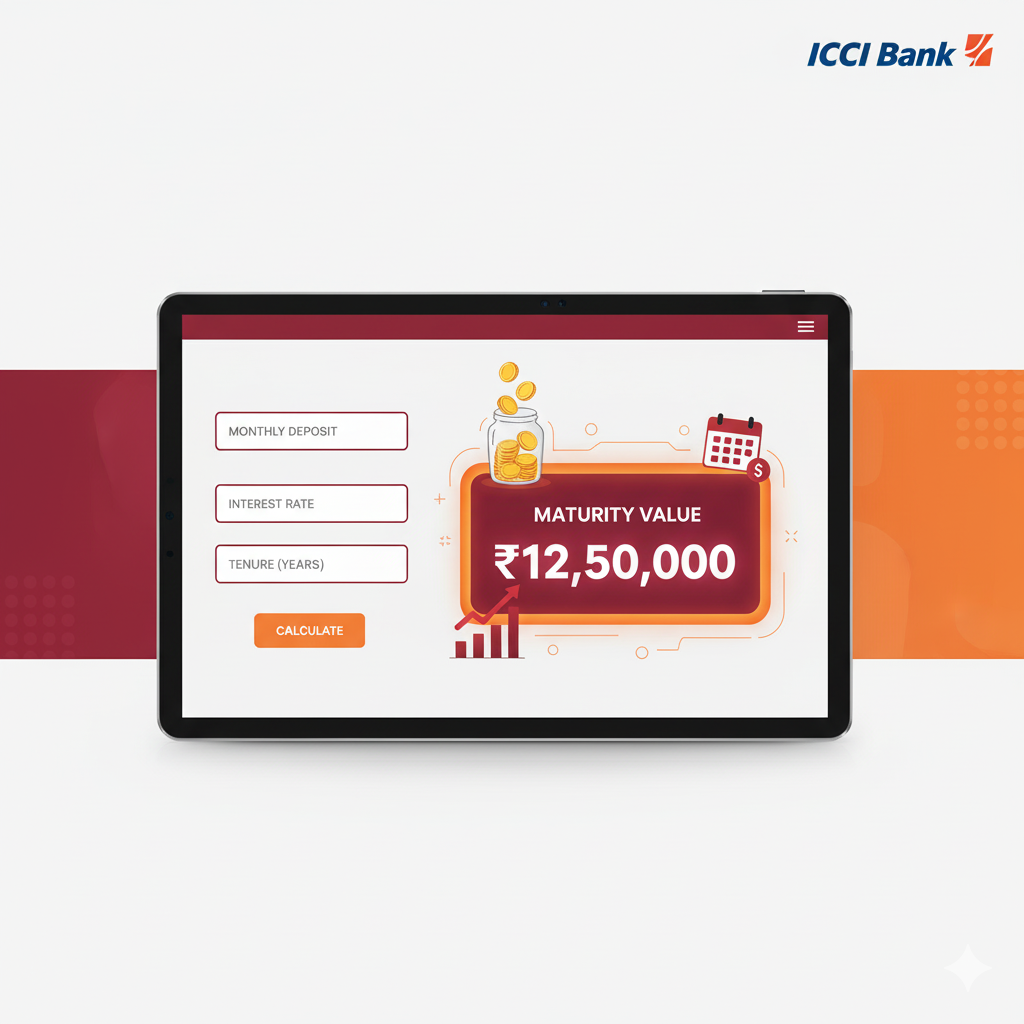
What the ICICI RD Calculator Does (and what it doesn’t)
An ICICI RD calculator typically accepts three or four inputs: monthly instalment (P), tenure (T), and the interest rate (R) — and sometimes compounding frequency (N). With those values it returns:
- Estimated maturity amount (A).
- Total principal invested (P × number of months).
- Interest earned over the tenure.
It’s important to know a calculator gives an estimate based on the interest rate you enter. If bank rates change, the maturity figure should be recalculated using the updated rate. ICICI Bank publishes RD rates by tenure; these are the rates you should feed into an RD calculator for accuracy. ICICI Bank+1
The math behind ICICI RD calculators (simple, exact)
Most RD calculators use the standard compounding formula adapted for monthly contributions. A widely used formula is:
A = P × [ (1 + r/n)^(n*t) − 1 ] × (1 + r/n) / (r/n)
Where:
- A = maturity amount
- P = monthly instalment
- r = annual interest rate (in decimal, e.g., 6.25% → 0.0625)
- n = number of compounding periods per year (quarterly compounding → n = 4; monthly approximation often assumes monthly compounding)
- t = tenure in years
Another common representation simplifies monthly RD compounding as:
Maturity = P × { [(1 + i)^m − 1] / (1 + i − 1) } ≈ P × [(1 + i)^m − 1] / i
Where i = monthly interest rate (r/12) and m = number of months. Different calculators may use quarterly compounding (n = 4) or approximate monthly compounding — always check the calculator’s notes. Groww+1
ICICI RD interest rates — what to expect (as of mid-2025)
ICICI Bank publishes tenure-wise RD interest rates on its website. Rates vary by tenure and by customer type (general vs senior citizen). For planning, you should use the most recent published RD rates when you plug numbers into the ICICI RD calculator. As an example of how rates can vary, ICICI’s published rate table (effective July 9, 2025) shows different rates across tenures such as 6 months, 12 months, 24 months, 36 months, and longer — with senior citizens getting an extra margin on many tenures. Because banks adjust deposit rates over time (for example after RBI policy moves), re-checking the official rate page before finalizing investments is recommended. ICICI Bank+1
How to use an ICICI RD calculator — step by step
Below is a practical step-by-step workflow to get realistic results:
- Find the latest RD interest rate from ICICI Bank for your intended tenure (use ICICI’s site or trusted financial portals). Enter this as the annual rate (R). ICICI Bank
- Decide monthly instalment (P). Choose an amount you can comfortably save month after month.
- Choose tenure (T). RD tenures typically range from as little as 6 months up to 10 years at some banks. Longer tenure often yields slightly different rates.
- Select compounding frequency (if the calculator asks). Some RD calculators assume monthly compounding; others use quarterly — note which one the tool uses.
- Run the calculation to get maturity amount, total contributions, and interest earned.
- Re-run for variations. Try different tenures or instalment amounts to match your target corpus.
This routine lets you reverse-engineer either the monthly instalment needed for a target corpus or the maturity you can expect from a fixed instalment. ClearTax+1
Example: Calculate returns with ICICI RD calculator (illustrative)
Let’s assume you plan to deposit ₹5,000 monthly for 3 years and the RD rate is 6.25% p.a. (use the current rate published by ICICI). Using the monthly compounding formula, the calculator will convert 6.25% to a monthly rate (0.0625/12), compute compound growth over 36 months, and return maturity amount and interest earned. This kind of worked example helps you see how small changes in tenure or rate significantly change the final corpus. (Note: always recompute with the exact rate shown on the ICICI site before acting.) ICICI Bank+1
Monthly instalment vs target corpus — reverse calculation
If your goal is to have a specific corpus at maturity (say ₹5,00,000 in 5 years), you can use an ICICI Bank RD Calculator in reverse mode: feed the target maturity, tenure, and rate, and solve for the monthly instalment required. Many online ICICI RD calculators support both forward (compute maturity) and backward (compute instalment) modes, or you can iteratively compute the instalment via Excel. Reverse planning is a powerful way to design disciplined savings aligned with life goals.
Senior citizens: special RD considerations
Senior citizens often earn an additional 0.25%–0.50% on bank deposit products including RDs. When you use an ICICI Bank RD Calculator and you qualify as a senior citizen, make sure to enter the senior citizen rate to avoid underestimating returns. Senior-citizen rates are explicitly noted on the bank’s RD interest rate table. ICICI Bank
How ICICI’s compounding choices affect results
Some calculators use quarterly compounding (n = 4), others an effective monthly compounding approximation. Because of compounding effects, the same nominal annual rate will yield slightly different effective results depending on compounding frequency. Generally, higher compounding frequency => slightly higher maturity for the same nominal rate. Always check the compounding convention the calculator assumes; the ICICI Bank page and reputable calculators document this choice. Groww+1
ICICI Bank RD Calculator vs generic RD calculators — what’s different?
A generic RD calculator will compute maturity from P, T, and R. The ICICI Bank RD Calculator is tailored to ICICI’s published rates and may include bank-specific rules such as minimum monthly instalment, allowed tenures, senior citizen rate options, nomination rules, or premature withdrawal charges. Using the bank’s named calculator (or a portal that mirrors its rules) reduces mismatch risk between the tool and the actual product terms. Angel One+1
Comparing ICICI RD with other savings instruments
When you calculate maturity with the ICICI RD calculator, you should also compare RD returns with other instruments like fixed deposits (FDs), systematic investment plans (SIPs) in mutual funds, or government small-savings schemes. RDs offer fixed, predictable returns and are low risk; FDs may give higher or lower returns depending on tenure and bank; SIPs accept market risk but historically produce higher long-term returns. Use the RD calculator to set a baseline guaranteed return, then compare risk/return tradeoffs. Recent bank reactions to RBI policy changes have led to some rate reductions across fixed deposits and RDs — a reminder to recompute when policy shifts occur. The Economic Times+1
Practical optimization tips when using an ICICI Bank RD Calculator
- Lock rates mentally: When you compute, assume the published rate remains unchanged for your tenure — but watch bank announcements. If rates fall, reinvesting new savings may earn less. ICICI Bank
- Round-trip test: Compute maturity for a given instalment, then use the reverse mode to confirm you get the same instalment for that maturity. This verifies the calculator’s compounding convention. Groww
- Factor in liquidity needs: RDs are not liquid without penalty. Use calculators to model emergency access: compare how much you’d lose if you have to break the RD early. ClearTax
- Senior citizen option: If you’re eligible, always compute both rates (general and senior) to see the delta. ICICI Bank
Stepwise ICICI RD calculator example with numbers (detailed)
Suppose you want to save for a 3-year goal with monthly deposits of ₹7,500 and the published RD rate for 36 months is 6.40% p.a. (note: use ICICI’s current table when you calculate). The procedure:
- Convert annual rate to monthly: r_month = 0.064 / 12.
- m = 36 months.
- Compute maturity using the formula in the earlier section; the calculator gives maturity and interest.
This real-numbers walk-through helps visualize how regular saving plus compounding grows over time. If you re-run the same numbers for 5 years at 6.60% the maturity difference illustrates the power of tenure and rate. Always cite the exact rate used; rates are time-sensitive. ICICI Bank+1
Where to find reputable IICICI Bank RD Calculator online
Several reputable portals either host an “ICICI RD calculator” or provide a generic RD calculator where you can set ICICI’s rate manually. Examples include the bank’s own page and widely used financial portals and brokerage sites that label calculators for ICICI. Using the bank’s official tool minimizes discrepancies. However, independent calculators (Groww, ClearTax, Scripbox, Angel One, etc.) are convenient and reliable for planning — make sure they disclose compounding conventions. ICICI Bank+2Groww+2
Common user mistakes when using ICICI Bank RD Calculator (and how to avoid them)
- Entering the wrong rate — using stale numbers leads to incorrect maturity estimates. Always verify the effective date on rate tables. ICICI Bank
- Ignoring compounding frequency — monthly vs quarterly makes a difference; it seems small but compounds over years. Groww
- Forgetting tax — interest earned on RDs is taxable as per your income slab; calculators usually show pre-tax maturity. Factor in tax to get after-tax return. ClearTax
- Using FD rates accidentally — FD and RD rates can differ; ensure you use the RD rate. ICICI Bank
Taxation and RD calculators — what to remember
Interest from an RD is fully taxable in the year it is earned. Banks may deduct Tax Collected at Source (TDS) if your interest crosses the threshold; however, the maturity interest is treated as income for each financial year as the interest accrues. Because calculators show gross maturity and interest, use an after-tax adjustment based on your marginal tax rate to obtain the realistic post-tax corpus. For precise tax treatment consult a tax advisor. ClearTax
How rate changes (RBI decisions) impact RD calculators
The Reserve Bank of India’s policy decisions — repo rate hikes or cuts — often cause banks to adjust deposit rates. When the RBI changed its policy, multiple private banks adjusted fixed deposit and RD rates in mid-2025; ICICI and other banks updated rates accordingly. That’s why anytime there’s an RBI action you should re-check ICICI’s RD rate table and re-run the ICICI RD calculator to see updated outcomes. The Economic Times+1
Comparing ICICI Bank RD Calculator outputs across portals
Different portals may show slight discrepancies because of: (a) compounding assumptions, (b) rounding rules, (c) whether they assume interest is paid monthly or quarterly for calculation, and (d) bank-specific minimum instalment rules. If you need the exact bank statement figure for documentation (for example, when evaluating maturity for loan collateral), use the ICICI Bank statement or ICICI’s official calculator and terms. ICICI Bank+1
Practical planning use cases for the ICICI RD calculator
- Goal planning: Save for a child’s tuition or a wedding target — calculate monthly instalments required.
- Emergency fund: Model how much a disciplined RD plan accumulates in 12–24 months.
- Tax planning: Simulate after-tax maturity for different tax slabs.
- Laddering: Use multiple RDs with staggered maturities and compute combined maturity using calculators. Each ladder rung can be modeled separately and then aggregated. ClearTax
Example ladder strategy using multiple RD calculator runs
Laddering means opening RDs that mature at different times so you have periodic liquidity. Using the ICICI RD calculator, simulate three RDs: a 12-month, 24-month, and 36-month, each with different monthly instalments. Add the expected maturity values to estimate total liquidity across time. Laddering smooths rate risk and gives periodic access to funds without early-withdrawal penalties.
Troubleshooting: if the ICICI RD calculator result differs from bank statements
If your calculated maturity is different from the bank’s official calculation:
- Confirm you used the exact rate the bank published for that tenure. ICICI Bank
- Check compounding frequency used by the calculator vs bank’s convention. Groww
- Ensure you entered the exact number of months (some calculators ask in years).
- Verify if the bank applies any rounding or other product-specific terms. If mismatch persists, consult ICICI Bank support.
Where to go from here: recommended action plan
- Visit ICICI Bank’s RD interest rate page and note the rate for your intended tenure. ICICI Bank
- Use an ICICI RD calculator (bank’s or a reliable third-party tool) to compute maturity and interest. Groww+1
- If you need after-tax values, apply your marginal tax rate to the interest component.
- Recompute if rates or tenure change.
Recent market context (brief)
In 2025 several banks adjusted deposit rates following RBI policy moves; private banks including ICICI have revised FD and RD rates in that context. That is a reminder that RD interest rates are not permanently fixed and you should re-run your ICICI RD calculator if economic policy or bank announcements change rates. The Economic Times+1
FAQs (concise, direct — no emoji)
Closing: Plan precisely, re-verify regularly
An ICICI Bank RD calculator or ICICI RD calculator is an indispensable planning tool for disciplined savers. It translates monthly routine into a target corpus and enables informed comparisons with other fixed-income options. For accurate planning: (1) use ICICI’s latest published RD rates, (2) confirm compounding conventions, (3) factor tax, and (4) re-run calculations when bank rates change. Using the calculator well turns monthly pennies into predictable progress toward your financial goals. ICICI Bank+1
Sources and further reading
- ICICI Bank — Recurring Deposit interest rates (official). ICICI Bank
- RD calculator explanations and formula references (Groww, ClearTax). Groww+1
- Financial portals with calculators (Scripbox, Angel One, StackWealth). Scripbox+2Angel One+2
- News coverage of rate changes following RBI policy moves. The Economic Times+1