HDFC RD Calculator
Calculate your HDFC Recurring Deposit returns
Introduction: Why an RD calculator matters for your savings plan
If you save a fixed amount each month, a Recurring Deposit (RD) can be one of the simplest, lowest-risk ways to build a corpus over time. An online RD calculator takes the manual math out of the process and shows you the estimated maturity value, interest earned, and how small changes in instalment or tenure affect returns. For HDFC customers and prospects searching terms like hdfc rd calculator, hdfc bank rd calculator, or hdfc rd calculator 2023, this guide explains how to use HDFC’s own RD calculator, how the formula works, practical examples, and how to optimize your savings.
HDFC Bank provides an online RD calculator as part of its tools and calculators suite; you can plug in your monthly deposit, tenure and interest rate to get the maturity amount quickly. HDFC Bank
What is an RD and how does it differ from other deposit products?
A Recurring Deposit is a scheduled savings plan where you deposit a fixed sum at regular intervals (typically monthly) for a pre-set tenure. Unlike a fixed deposit (FD), where you deposit a lump sum upfront, an RD is suitable for regular savers who prefer to invest small amounts periodically. RDs usually earn interest that is compounded at the frequency the bank specifies (commonly quarterly in India), and interest rates for RDs mirror the fixed deposit rates offered by the bank. HDFC Bank explicitly states that RD interest rates correspond to the FD rates and that calculation is performed on an actual/actual quarterly compounding basis. HDFC Bank+1
Why use the HDFC RD calculator instead of doing the math yourself?
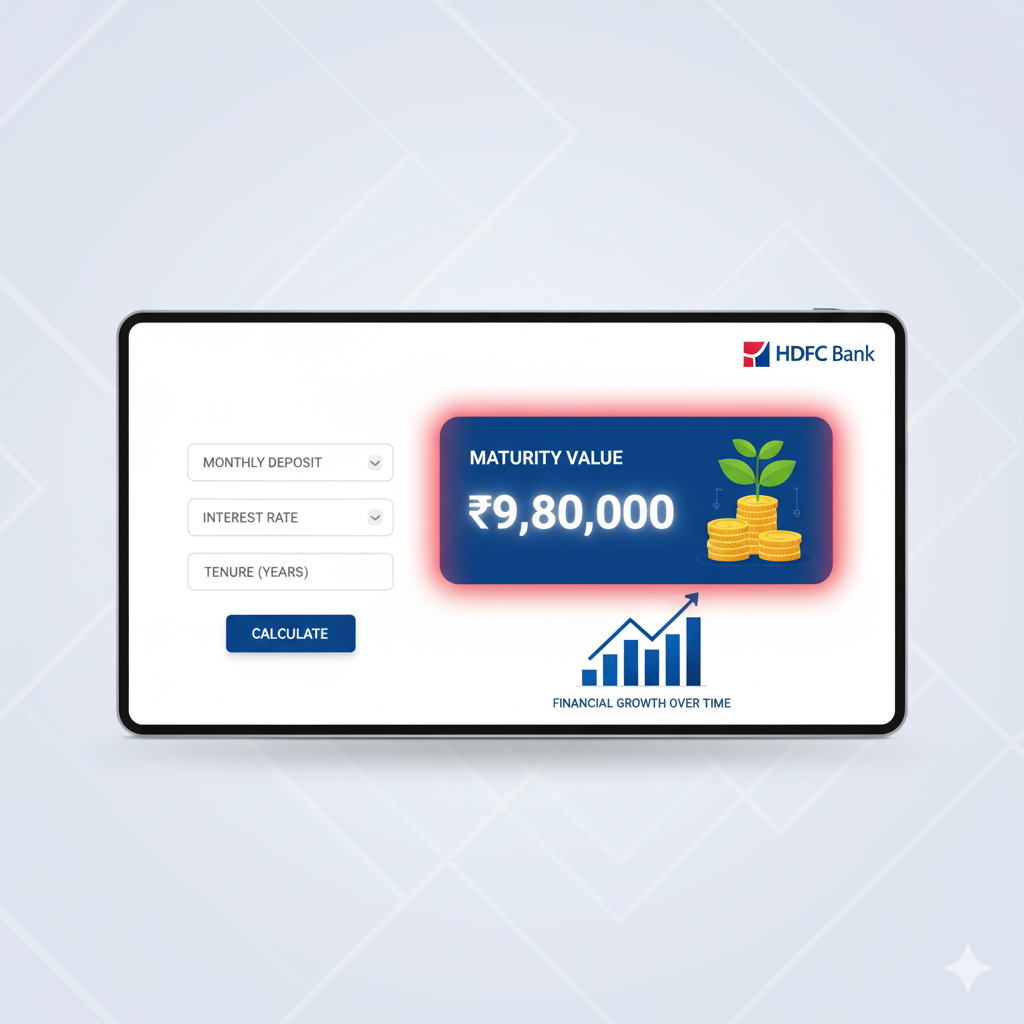
Manual RD math is error-prone: the compounding schedule, exact instalment dates, and varying interest rate slabs make hand calculations tedious. The HDFC RD calculator automates these details, giving you an indicative maturity amount instantly. It’s especially useful when you’re comparing multiple tenures or varying monthly contributions because you can iterate quickly to find the combination that meets your financial goal. HDFC’s online tool is designed to be simple: input the monthly deposit, tenure, and the interest rate (or select the bank’s current rate), and the calculator returns the maturity amount and total interest earned. HDFC Bank
The RD maturity formula — how the calculator actually computes your returns
The most important formula behind every RD calculator is the maturity formula for recurring deposits. While different presentations exist, a widely used expression for discrete monthly instalments with periodic compounding is derived from summing the future values of each instalment. In practical terms, calculators commonly use an equivalent formula:
A = P × [ ( (1 + r/n)^(n×t) − 1 ) / (1 − (1 + r/n)^(-1/n) ) ]
A simpler and commonly shown form is:
A = P × (1 + r/n)^(n×t) + P × (1 + r/n)^(n×t − 1) + ... (sum of compounding each instalment)
Where:
- A = maturity amount
- P = monthly instalment (deposit)
- r = annual interest rate (decimal, e.g., 0.06 for 6%)
- n = number of compounding periods per year (for quarterly compounding n = 4)
- t = tenure in years
Third-party calculators and financial literacy pages also present a compact version: A = P × (1+R/N)^(N*t) etc., and they explain the compounding frequency and instalment timing. For practical use, HDFC’s tools and most Indian banking calculators use quarterly compounding and compute interest based on instalment dates. bankbazaar.com+1
How to use the HDFC Bank RD calculator — step-by-step
To use the HDFC RD calculator effectively:
- Determine how much you can invest monthly (the instalment P). HDFC typically allows small minimum instalments and wide maximums. Groww
- Decide the tenure (in months or years). RD tenures usually start from six months for resident Indians (NRIs may have different minimums). Groww
- Choose the interest rate: you can either pick the current bank rate (HDFC publishes tenure-wise rates) or enter a hypothetical rate to model scenarios. HDFC provides a rates page where RD/FD interest details are listed. HDFC Bank+1
- Input the details into the HDFC RD calculator and read off the maturity amount and total interest. The calculator gives an indicative figure; the bank’s official RD advice on account opening will specify the exact maturity value. HDFC Bank+1
A worked example: using the HDFC RD calculator for clarity
Imagine you save ₹2,000 every month for 5 years (60 months) and you want to approximate the maturity value using an RD rate of 6.50% p.a. with quarterly compounding.
The calculator will treat each monthly instalment as a separate flow and compound it to maturity according to the compounding schedule. Instead of manually summing dozens of future values, the HDFC RD calculator runs the formula and returns the maturity corpus and the total interest earned. This process shows the power of the calculator: an immediate, accurate projection of long-term savings.
For an exact computational sample, external calculators such as those on BankBazaar, Groww, or ClearTax demonstrate the step-by-step math that underlies such outputs. bankbazaar.com+2Groww+2
HDFC RD calculator 2023 — why people search this phrase and how to use it now
Many users search hdfc rd calculator 2023 because they want an example or snapshot reflecting the interest rates and expectations from that calendar year: perhaps they opened an RD in 2023 or want to compare historical returns. The calculator itself is timeless — the math doesn’t change — but the input rates do. If you want a historical simulation for 2023, use the HDFC RD calculator and enter the interest rate that was applicable in 2023 for the tenure you had. HDFC’s rates and customer notices archive can help you find the precise rate that applied then, and the online tool will convert those inputs into the maturity amount for historical planning.
Note: interest rates change over time and banks periodically revise FD/RD rates according to market conditions; always use the exact historical rate if you need an accurate retrospective calculation rather than an estimate. HDFC publishes its rates and changes; consult the bank’s rates pages or the relevant historical notices for the exact 2023 figures if you need them. HDFC Bank+1
Common RD scenarios you can model with the HDFC RD calculator
Use the HDFC RD calculator to test scenarios such as:
- Increasing the monthly instalment gradually to reach a higher corpus.
- Choosing different tenures (shorter vs longer) to see how compounding affects returns.
- Simulating post-tax returns by subtracting expected tax on interest (and accounting for TDS where applicable).
- Modeling the effect of bank rate revisions by recalculating maturity using different interest rates (e.g., rates in 2023 vs rates today).
Because HDFC’s calculator gives you an indicative maturity amount, it’s also suitable for quick comparisons when weighing RDs against other fixed-income instruments.
How HDFC determines RD/FD rates and why they change
Banks set deposit rates based on money market conditions, the Reserve Bank of India’s policy rate movements, competition among banks, and their own liquidity needs. HDFC, like other banks, periodically revises its FD and RD rates; historical and recent examples show such adjustments. For instance, in 2024–2025 HDFC made several rate changes in response to macroeconomic shifts. Because RD rates are aligned with FD rates, changes to FDs typically apply to RDs as well. If you want to compare 2023 to later years, check the official rate notices to see the precise tenures and the interest percentages that applied then. The Economic Times+1
Practical tips for maximizing RD returns with HDFC Bank
- Start early and be consistent: the sooner you begin, the more instalments benefit from compounding.
- Choose a tenure that aligns with your goal—longer tenures generally leverage compounding more, but you should balance this against liquidity needs.
- If rates rise materially, consider shifting new investments to higher-yield instruments; if rates fall, lock in the longer tenure if you’re satisfied with the rate today.
- Watch for senior citizen benefits: many banks, HDFC included, offer higher rates for senior citizens on certain tenures. Always check the bank’s published senior citizen rate schedule. HDFC Bank
RD vs SIP vs FD — how to choose
Recurring deposit (RD): disciplined monthly saving into a bank vehicle, capital protection, fixed interest.
Systematic Investment Plan (SIP) in mutual funds: market-linked returns; potential for higher long-term gains but with higher volatility.
Fixed deposit (FD): lump-sum deposit, fixed return, higher liquidity penalties for premature withdrawal.
If your priority is capital preservation with a predictable return, an RD may be appropriate. For building an emergency corpus or fixed-goal corpus with disciplined monthly investments, RD’s predictability is a strength. Use the HDFC RD calculator to compare outcomes against hypothetical SIP returns or FD alternatives to see which better serves your objectives.
How taxes and TDS affect RD returns (what the calculator does not handle automatically)
RD interest is taxable as per your income tax slab in India, and banks may deduct TDS if interest exceeds the thresholds set by the Income Tax Department. Calculators usually show gross maturity and interest, not post-tax proceeds. To estimate after-tax returns, compute your expected tax liability on interest and subtract it from the interest figure the calculator provides. Also keep in mind any TDS that may have been deducted at source; TDS is an interim mechanism and the final tax depends on your return filing and slab. HDFC’s product documentation and general bank notices explain that TDS on RD is applicable as per law and is recovered from the linked CASA account. HDFC Bank
UX and SEO tips: optimizing a page for keywords like “hdfc rd calculator” and “hdfc rd calculator 2023”
If your objective is to rank for the keywords you provided, follow these practical on-page strategies:
- Use the exact keywords in the main title (H1) and in at least one subheading (H2).
- Place the primary keyword in the first 100 words without keyword stuffing—make it natural.
- Provide variations and LSI words across the content: “recurring deposit calculator,” “RD maturity calculator,” “HDFC RD interest rate,” “RD calculator 2023,” etc.
- Create a small table or example calculation (visible and helpful) so search engines can pick up structured content; but don’t over-bullets—use short paragraphs and occasional inline numeric examples.
- Include an FAQ section that answers common long-tail queries related to the primary keywords. (Note: you requested no "❓" glyph in the FAQ; the below FAQ entries are phrased as short questions in plain text.)
- Add schema where possible (FAQ schema, HowTo schema for step-by-step calculator use) so SERPs can show rich results.
- Keep content evergreen: explain how to enter a historical rate (e.g., "enter the 2023 rate if calculating a past RD"), and add a date-stamped note explaining when the page was last reviewed.
These SEO signals help both readers and search engines understand relevance.
Real user scenarios: 4 examples showing why an RD calculator helps
- Young professional saving for a laptop: use the RD calculator to determine monthly instalments to reach the target by a set date.
- Parent saving for a child’s education: test different tenures and instalments to align with school start dates.
- Someone who opened an RD in 2023 and wants to check if the maturity estimates quoted then match actual: enter the 2023 interest rate into the HDFC RD calculator to replicate the bank’s projection. HDFC Bank
- Retiree comparing RDs vs short-term FDs: use the tool to simulate both and compare maturity and compounding effects over the same horizon.
Limitations of any online calculator (and how to overcome them)
Online calculators present indicative figures. For exact numbers:
- The bank will compute interest based on actual instalment dates and their internal system; rounding rules or special day-count conventions may cause slight differences. HDFC warns that calculator amounts are indicative and the final RD advice/documentation contains the official figures. HDFC Bank+1
- Calculators do not typically account for tax at source or your personal tax bracket—adjust for tax manually.
- If rates change during your RD’s tenure (rare for locked RD terms), the maturity may not be retroactively altered, but ongoing new RDs booked later will use the new rate. For a fully accurate historical calculation, use the exact rate that applied when instalments were made.
Comparison: HDFC RD calculator vs third-party calculators
Third-party financial portals (BankBazaar, Groww, ClearTax, etc.) provide RD calculators that are functionally similar and useful for quick comparisons. The advantage of HDFC’s own calculator is that it’s directly linked to the bank’s product definitions and interest schedules; that makes it convenient for HDFC customers. Third-party calculators often offer additional UX features, like exporting schedules or showing side-by-side comparisons — useful for research before you commit. If you need to replicate a bank-specific RD (e.g., HDFC RD calculator 2023), use HDFC’s calculator or ensure you input the exact historical rate into any third-party tool. bankbazaar.com+1
UX: What fields the HDFC RD calculator asks for (and why)
Typical input fields include:
- Monthly instalment amount (P)
- Tenure (months or years)
- Interest rate (annual percentage) — or the option to pick the bank’s current rate.
Optional outputs may include total instalments paid, interest earned, and maturity amount. HDFC’s tool and most reputable calculators display these fields clearly and label results as “indicative.” HDFC Bank
Keeping an eye on rates: why 2023 vs 2024 vs 2025 matters
Interest rates move with macroeconomic cycles. For example, HDFC and other banks revised deposit rates several times in 2024–2025. If you’re comparing outcomes from 2023 to the present, note that rate cuts or hikes will materially change maturity amounts for identical instalments and tenures. If you want to show historical performance precisely, use the exact historical rates for the period (enter the 2023 rate into the RD calculator), and clearly label the period in your content to avoid confusion. Recent bank communications also clarify when the RD/FD rates were revised and how it affects new customers. The Economic Times+1
FAQ (frequently asked questions) — clear answers for readers
Quick checklist before opening an RD at HDFC
Ensure you:
- Know the monthly instalment you can commit to.
- Select a tenure that matches your savings goal.
- Check the latest HDFC RD/FD rates from the bank’s rates page and make a note of senior citizen benefits if applicable. HDFC Bank
- Consider tax implications and whether TDS will apply. HDFC Bank
Closing: Use the calculator, but match it to your plan
The hdfc rd calculator and hdfc bank rd calculator are practical tools for disciplined savers who prefer predictable, bank-guaranteed returns. If you are specifically researching hdfc rd calculator 2023, use the historical rate applicable in that calendar year to reproduce accurate past outcomes. Remember the calculator’s maturity figures are indicative; always verify the final numbers with the bank’s RD advice at the time of account opening.
For the most accurate, current rates and the official HDFC RD calculator interface, use HDFC Bank’s tools and rate pages directly. HDFC Bank+1
Sources and further reading
- HDFC Bank — RD Calculator (official tools & calculators). HDFC Bank
- HDFC Bank — Current FD/RD interest rate pages and product notices. HDFC Bank+1
- HDFC Bank Learning Centre — Recurring Deposit formula and explanatory guide. HDFC Bank
- BankBazaar / Groww — RD formula explanation and independent RD calculators for comparison. bankbazaar.com+1
- Recent reporting on rate changes affecting deposit rates (context for 2024–2025). The Economic Times+1