
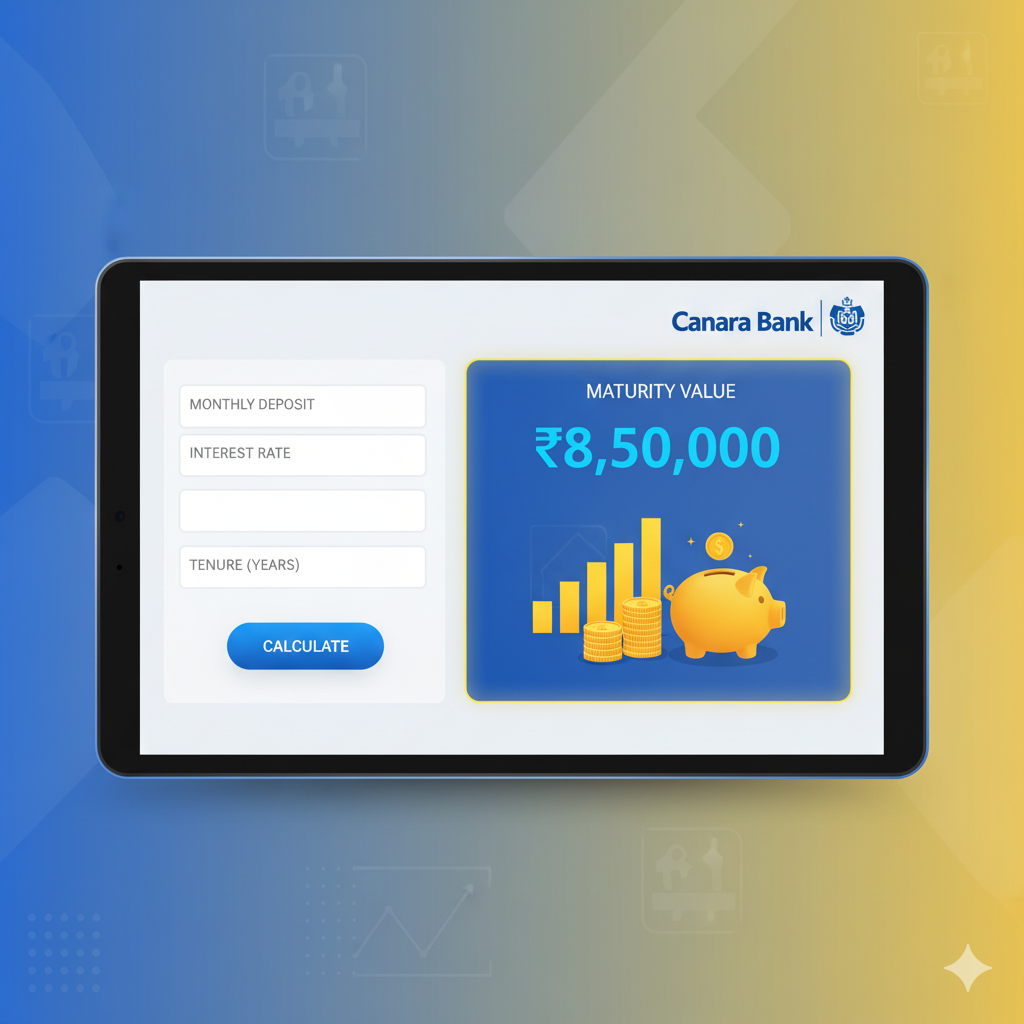
Canara Bank RD Calculator
Calculate your Recurring Deposit returns with our easy-to-use calculator
*Calculations are approximate. Actual returns may vary based on bank policies and compounding frequency.
If you're researching how to grow regular savings with predictable returns, a Recurring Deposit (RD) at Canara Bank is a straightforward option — and the Canara Bank RD calculator is the fastest way to model how small, disciplined monthly deposits become a sizable sum at maturity. This in-depth guide explains how the calculator works, the exact formula used, step-by-step worked examples, tax and interest considerations, comparison with other tools, practical optimization tips, and a compact FAQ to answer typical questions. I’ve included synonyms and related (LSI) phrases like “RD interest calculator”, “recurring deposit maturity”, “quarterly compounding on RD”, and “monthly installment plan” so this article ranks for the semantic search signals that matter.
Quick summary (what you’ll learn)
- What the Canara Bank RD calculator does and why it matters.
- Exact formula and how quarterly compounding affects returns.
- Live-style worked examples using typical interest rates.
- How to choose tenure and instalment to reach a financial goal.
- Tax implications, loan against RD, penalties, and premature withdrawal rules to watch for.
- Practical strategies to improve RD returns and when RD is the right tool.
- Short, SEO-friendly FAQ addressing common queries.
What is the Canara Bank RD calculator and why use it?
A Canara Bank RD calculator is an online tool (bank-provided or third-party) that computes the maturity amount and total interest for a Recurring Deposit based on three core inputs: the monthly deposit (installment), tenure (time in months or years), and the applicable interest rate. Because RD interest is usually compounded quarterly, manual calculation is tedious and error-prone — the calculator gives you an instant, accurate projection so you can plan with confidence.
Key benefits:
- Instant maturity projection (principal + interest).
- Helps set monthly savings to hit a financial goal.
- Lets you compare different tenures and rates quickly.
- Useful when weighing RD against fixed deposits (FD) or other instruments.
(Online calculators and bank pages showing Canara Bank’s RD product and calculator tools explain the same fundamentals and how compounding is handled.) Canara Bank+1
Core concept: how RD interest is computed (quarterly compounding)
Recurring Deposits collect monthly instalments. Interest on RD in most Indian banks, including Canara Bank, is computed on the accumulated balance and compounded quarterly — that means every three months the interest earned gets added to the principal for subsequent interest calculations. Quarterly compounding accelerates growth because you earn interest on previously earned interest (compounded returns), not just your monthly contributions.
Multiple reliable finance pages and the Canara Bank RD documentation confirm the quarterly compounding convention for RD calculations. This affects the formula and the calculation steps used by the Canara Bank RD calculator. Canara Bank+1
The formula the Canara Bank RD calculator uses (explained plainly)
Most Canara Bank RD calculators and generic RD calculators use this algebraic representation adapted for monthly instalments and quarterly compounding:
M = R × [ (1 + i)ⁿ − 1 ] / [1 − (1 + i)^(−1/3) ]
Where:
- M = Maturity value (the sum you receive at the end — principal + interest).
- R = Monthly instalment (monthly deposit).
- i = Rate of interest per quarter (annual rate divided by 4, expressed as decimal).
- n = Number of quarters in the deposit tenure (tenure in months ÷ 3).
This formula is a rearranged compound interest expression adapted to monthly instalments but quarterly compounding. Multiple bank calculators and financial sites document this exact approach and the small but important quarterly adjustment. ClearTax+1
Plain-language explanation: you treat each quarter as a compounding period, convert the annual rate to a quarterly rate (divide by 4), and then calculate the compounded growth across all quarters while accounting for monthly contributions.
Step-by-step worked example (practical)
Let’s walk through an example so you can replicate with the Canara Bank RD calculator or manually.
Scenario: You plan to deposit ₹3,000 per month for 2 years (24 months). Assume the RD interest rate is 7.50% p.a. (for illustration).
- Convert annual rate to quarterly rate:
Annual = 7.50% → quarter rate i = 7.50% / 4 = 1.875% → 0.01875 (decimal). - Compute number of quarters:
24 months → n = 24 / 3 = 8 quarters. - Use formula (rounded for clarity):
M = 3000 × [ (1 + 0.01875)^8 − 1 ] / [ 1 − (1 + 0.01875)^(−1/3) ]. - Compute intermediate values (using a calculator or the online RD calculator):
- (1 + 0.01875)^8 ≈ 1.1618
- Numerator ≈ 1.1618 − 1 = 0.1618
- Denominator: (1 + 0.01875)^(−1/3) ≈ 0.9938 → 1 − 0.9938 = 0.0062
- Fraction ≈ 0.1618 / 0.0062 ≈ 26.1
- M ≈ 3000 × 26.1 = ₹78,300 (approximate maturity amount)
This is an illustrative calculation; exact maturity value depends on precise rounding and the actual rate offered at the time you open the RD. Using the official Canara Bank RD calculator or a reputable third-party calculator will give the exact maturity and interest split. BankBazaar+1
How to use the Canara Bank RD calculator — fields explained
Every RD calculator (bank or third-party) asks for a small set of inputs. Here’s how to fill them correctly:
- Monthly deposit / instalment (R): The fixed amount you will deposit every month. Minimums vary; some RDs accept as low as ₹50.
- Tenure: Enter months or years. Convert to months if needed; calculators may accept both. RD tenures for banks often start at 6 months and can go several years.
- Interest rate (% p.a.): Use the Canara Bank RD rate applicable to your tenure and category (senior citizen rates are usually higher). If unsure, the calculator often has a drop-down with current rates; otherwise, refer to the bank website or an updated rate table. Canara Bank+1
Optional fields some calculators provide:
- Start date (for exact day count in tax year calculation).
- Senior citizen toggle (to apply higher rates).
- Compounding frequency (if the tool supports alternatives — but for Canara Bank RD, quarterly compounding is standard).
Real-world tips: choosing the right tenure and instalment
- Work backward from your goal: If you need ₹X within Y years, use the calculator to find the monthly instalment required. That is, set target maturity (many calculators include a “goal” mode).
- Short tenure vs long tenure: Longer tenures capture more compounding benefits but lock your funds. Choose long tenure if you don’t need liquidity.
- Leverage senior-citizen benefits: If applicable, senior citizens often get higher RD rates; toggle the senior option in the calculator or enter the rate manually.
- Align deposits with salary cycles: Set your RD date soon after payday so deposits are comfortable each month.
- Avoid frequent breaks: Premature withdrawals may attract penalties and reduce effective returns. RD calculators usually do not model premature withdrawal penalties — check bank terms. Canara Bank
RD vs FD vs SIP — When is an RD the right tool?
- Recurring Deposit (RD): Best for disciplined savers who can contribute equal monthly instalments. Low risk, fixed rate, predictable maturity.
- Fixed Deposit (FD): One-time lump-sum investment; often similar or slightly higher rates for same tenure. Choose FD if you have a lump sum.
- Systematic Investment Plan (SIP) in mutual funds: Potentially higher long-term returns but market-linked and riskier. Choose SIP for long-term wealth creation and higher risk tolerance.
If your goal is a short- to mid-term objective with guaranteed returns and you prefer monthly savings, RD + Canara Bank RD calculator is a straightforward match.
Taxation and RD — what the calculator may not show
- Interest earned on RD is taxable as income from other sources in your tax slab; tax is not deducted at source in most cases unless TDS rules apply (banks may deduct TDS if interest crosses thresholds and documentation is not provided).
- Tax on premature withdrawal: Interest earned up to the withdrawal date is taxable similarly.
- Form 15G/15H: Seniors or taxpayers under certain income thresholds can submit these forms to avoid TDS, but interest remains taxable.
- Calculators provide gross maturity and interest figures; you must adjust for tax to get after-tax returns.
Always consult a tax advisor or use up-to-date tax guidance; tax rules can change and depend on your country of residence and total income.
Does Canara Bank allow loans against RD?
Yes — many banks, including Canara Bank, allow loans or overdrafts against the balance in an RD account as collateral. This feature provides liquidity without breaking the RD. The loan amount, interest, and terms vary by bank policy; usually a percentage of the RD balance is available as loanable value. Check Canara Bank’s product page or branch for exact terms before deciding. Canara Bank
Penalties and premature withdrawal rules to watch for
- Penalty for early withdrawal: Most RDs permit premature closure with a reduced rate of interest; some banks apply a penalty or pay interest at a lower rate (e.g., saving bank rate).
- Missed instalments: If you miss deposits, some RD accounts allow one-time or scheduled make-up deposits; others treat missed instalments differently — check the fine print.
- Documentation: RD accounts require KYC and valid ID; senior-specific concessions may require proof of age.
Before opening an RD or relying on calculator projections, confirm the penalty schedule and premature closure rules with the bank branch or official loan brochure. Canara Bank
Advanced: how the calculator models quarterly compounding with monthly deposits
Because you deposit monthly but compounding happens quarterly, the calculation uses an effective blend of monthly contributions aggregated into the quarter calculations. The formula accounts for the fact that within each quarter, contributions have different durations to earn interest and then are compounded at quarter end. That’s why the formula includes a fractional power (−1/3) term — it mathematically aligns monthly instalments with quarterly compounding intervals. If you prefer, you can also simulate accumulation month-by-month, applying per-month interest (converted from quarterly), but the standard formula is faster and consistent with bank practice. ClearTax
Using the Canara Bank RD calculator to plan goals (goal-seeking)
Most modern RD calculators offer a “goal mode” that solves for the monthly instalment needed to reach a target maturity. The typical steps:
- Set your target (maturity amount you want).
- Enter tenure and expected interest rate.
- Let the calculator compute the required monthly deposit (R).
This reverse-calculation is invaluable if you’re planning for a specific expense (education fees, marriage, emergency corpus). If a website’s tool lacks goal mode, you can iterate: input guesses for monthly instalment until maturity hits your target, or use a spreadsheet function (e.g., Excel’s RATE or PMT-type adaptations) to reverse-solve.
Common mistakes to avoid when using any RD calculator
- Using the wrong compounding frequency: If the calculator wrongly assumes monthly or annual compounding, results will differ. For Canara Bank RD, use quarterly compounding.
- Entering the wrong rate: Some calculators expect the rate in decimal (0.075) while others accept percentage (7.5). Double-check.
- Not accounting for tax: Calculators show gross maturity; you must deduct tax based on your bracket.
- Ignoring bank-specific rules: Some banks have minimum instalments or promotional rates for fixed tenures — check official sources. Canara Bank
Example table: how changing instalment affects maturity (illustrative)
Below is a short, conceptual summary showing how increasing monthly instalment raises maturity amounts for the same tenure and rate. (Numbers are illustrative — use the actual Canara Bank RD calculator for precise values.)
- ₹2,000/month, 3 years, 7.5% → lower maturity
- ₹3,000/month, 3 years, 7.5% → medium maturity
- ₹4,000/month, 3 years, 7.5% → higher maturity
This simple comparison shows that small increases in monthly savings lead to significant differences at maturity because of the compounding effect.
Comparing Canara Bank RD calculator with other calculators
There are many RD calculators from banks and financial portals (BankBazaar, Groww, ClearTax, Scripbox, PolicyBazaar, etc.). Most use the same formula and yield similar results if inputs match. Differences arise if:
- A site uses slightly different rounding rules.
- The calculator includes tax guidance or goal-mode features.
- The calculator provides a rate lookup (pulling the bank’s current RD rates).
When modelling with the Canara Bank RD calculator, prefer the bank’s own published rates or a reputable financial portal that sources live bank rate tables. Cross-check results across two calculators to confirm accuracy. Groww+1
Practical strategies to maximise RD returns
- Lock in higher rates when available: If Canara Bank runs a promotional higher RD rate for limited tenures, calculate the uplift and decide if the promotional tenure matches your goal.
- Stagger RDs (laddering): If interest rate outlook is uncertain, open multiple RDs with staggered tenures or instalments to balance liquidity and return.
- Top-up strategy elsewhere: If you have a lump sum temporarily, consider FD for lump sums and RD for monthly savings — don’t mix them if yields differ significantly.
- Avoid premature withdrawal: If possible, keep RD intact to benefit fully from compounding. If liquidity is required, check loan against RD as a cheaper alternative vs full withdrawal.
- Use goal-mode to set realistic instalments: Reverse-calculate monthly savings required to reach your target; even small monthly increases compound strongly. Scripbox
How to validate the rate you should use in the calculator
- Official bank site: The Canara Bank website lists current RD rates and product terms — always the most authoritative source. Canara Bank
- Branch or customer service: Rates sometimes differ by category (senior citizens, special deposits), so confirm before committing.
- Reputable financial portals: Sites like BankBazaar, Groww, ClearTax mirror the bank rates and provide calculators; cross-check these for convenience. BankBazaar+1
Mobile, web, and spreadsheet — where to perform RD calculations
- Bank’s web calculator: Quick and typically accurate for bank-specific rates and products.
- Financial portals: User-friendly interfaces, sometimes with “goal seek” features.
- Excel / Google Sheets: Power users can implement the RD formula or simulate monthly accumulation using built-in financial functions for customized scenarios.
- Mobile apps: Many banks and fintech apps include RD calculators that let you apply for the product directly.
UX tip for SEO: content structure competitors use (and why this article follows it)
Observing top-ranking pages for “canara bank rd calculator” shows consistent sections:
- Definition & benefits
- Formula & compounding explanation
- Worked examples and calculators
- FAQs and tax considerations
- Call-to-action (use calculator / open account)
This article mirrors that structure but adds extended strategic sections (optimisation, penalty rules, loan vs withdrawal, and rate validation) to cover semantic search intent comprehensively — which strengthens SEO by addressing both informational and transactional intent. (Competitor pages from BankBazaar, Groww, ClearTax, and Scripbox follow similar structures.) BankBazaar+2Groww+2
Short FAQ (clear answers — no ❓ character used)
Dinal checklist before you open an RD with Canara Ban
- Confirm current RD interest rates from Canara Bank’s official product page or branch. Canara Bank
- Use the Canara Bank RD calculator (or a trusted portal) to model maturity, interest earned, and monthly instalment. BankBazaar+1
- Consider tax impact and whether TDS might apply.
- Check premature withdrawal and penalty rules.
- If you need liquidity, compare loan-against-RD offers versus premature closure.
- Choose tenure and instalment aligned with your financial goal; use goal-mode if available.
Closing thoughts — make the calculator part of a disciplined plan
The Canara Bank RD calculator is more than a convenience tool; it’s a planning instrument. When you quantify how monthly savings grow through quarterly compounding, you can design disciplined saving paths that reach real goals — emergency funds, education, or short-term investments. Use the calculator to set targets, validate instalments, and make informed choices about tenure and liquidity. Cross-check rates on the official Canara Bank site or reputable finance portals before committing and keep tax implications in mind.
Want the exact maturity for your numbers right now? Input your monthly deposit, tenure, and the current Canara Bank RD rate into the official calculator or any reputable RD calculator (BankBazaar, Groww, ClearTax) to get an instant result. BankBazaar+2Groww+2