
BOB RD Calculator
Calculate your Recurring Deposit returns
Enter the amount you plan to deposit every month
Current BOB RD rate is around 6.5% per annum
Select the duration of your RD
Calculation Breakdown
This calculator provides estimates only. Actual returns may vary based on Bank of Baroda’s current rates and terms.
Recurring deposits remain one of the simplest and most reliable tools for disciplined savers. For customers of Bank of Baroda (BOB), the bob rd calculator is a convenient online instrument that estimates the maturity amount and interest earned on a recurring deposit by simulating quarterly compounding and tenure effects. This guide explains what the BOB RD calculator does, how it computes returns, practical examples, planning tips, common pitfalls, comparisons with other calculators, and an FAQ to help you maximize the benefits of recurring deposits.
What is a bob rd calculator
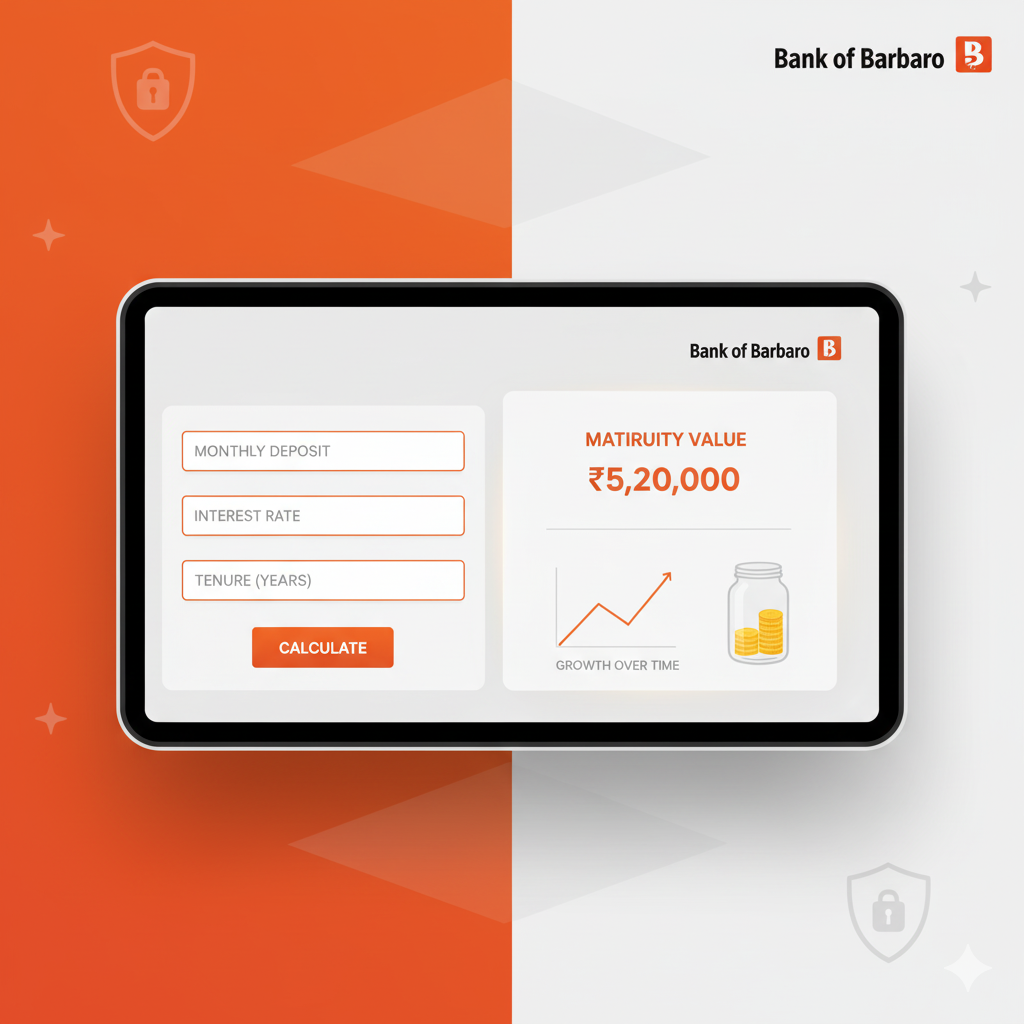
A bob rd calculator is a digital calculator branded for Bank of Baroda that accepts your monthly deposit amount, tenure, and interest rate to compute the maturity amount and total interest earned on a recurring deposit. In essence, it helps you answer the question “If I save X per month for Y years at Z% annual interest, how much will I have at maturity?” without manual math. The official Bank of Baroda website provides an RD calculator tailored to its product rules and compounding schedule. bankofbaroda.in+1
The advantages of using this tool are immediate: accuracy in calculation, the ability to test multiple deposit and tenure combinations, and faster financial planning without visiting a branch. Third-party financial platforms and comparison sites also offer “BOB RD calculator” interfaces that use the same underlying math. Groww+1
Why RD calculators matter for savers
Recurring deposits package saving discipline and predictable returns. However, the math behind recurring deposits is not as trivial as multiplying months and interest, because interest typically compounds periodically. An RD calculator removes manual errors, demonstrates the power of compound interest, and can be used to reverse-engineer a plan (for example, determine how much to deposit monthly to reach a future target).
Key planning benefits:
- Instant estimates for maturity value and total interest.
- Comparison across tenures and interest rates to select the best option.
- Scenario planning for goals like education, a vacation, or a down payment.
- Clarifies the impact of compounding frequency and rate changes.
Using a BOB-specific calculator is especially helpful because banks sometimes use specific compounding rules and give senior citizens preferred rates; the official tool reflects those conventions. bankofbaroda.in+1
How the bob rd calculator computes returns — the math explained
Understanding the mechanics behind the bob rd calculator helps you interpret results and spot mistakes. Recurring deposits involve a series of equal monthly deposits, with interest added periodically. Most Indian banks, including Bank of Baroda, calculate RD interest using quarterly compounding. That means interest accrues and is compounded at the end of each quarter. Groww+1
A commonly used formula for recurring deposits uses effective periodic interest to aggregate the value of each monthly installment at maturity. One of the standard formulas presented by multiple financial resources is:
M = P × [(1 + r/n)^(nt) − 1] ÷ [1 − (1 + r/n)^(−1/3)]
Where:
- M is the maturity amount.
- P is the monthly instalment (deposit).
- r is the annual nominal interest rate (in decimal).
- n is number of compounding periods per year (for quarterly compounding, n = 4).
- t is tenure in years.
Different resources express the formula in slightly different algebraic forms, but they compute the same result if compounding convention is consistent. The formula aggregates the future values of each monthly deposit as they compound until the end of tenure. ClearTax+1
Intuition without heavy algebra
If you don’t want to memorize the formula, think of the process this way: each monthly deposit sits inside the deposit for a different length of time. The earlier deposits earn interest for a longer period. The calculator computes the compounded future value of each monthly deposit, sums them, and reports the total maturity amount and total interest earned.
Step-by-step: Using the official Bank of Baroda RD calculator
Using the BOB RD calculator is straightforward. Here’s the typical flow and why each input matters:
- Enter monthly deposit amount: This is the fixed contribution you make every month.
- Select tenure: Enter the total duration of the RD expressed in months or years. Tenure determines how many quarters apply for compounding.
- Enter interest rate: Use the applicable Bank of Baroda RD rate for the selected tenure. If you’re a senior citizen, add the extra margin if BOB specifies it.
- Press calculate: The calculator applies quarterly compounding rules and returns two key numbers — maturity amount and total interest earned.
The calculator may also present a year-wise breakup of interest earned or a simple summary of total investment versus return. The bank’s official portal and regional BOB sites provide the tool; the interface sometimes differs, but the mathematical core remains the same. bankofbaroda.in+1
Real-world examples with the bob rd calculator
Practical examples help illustrate the power of compounding and how small monthly increases can make a big difference at maturity.
Example 1: Conservative saver
- Monthly deposit: ₹2,000
- Tenure: 3 years (36 months)
- Interest rate: 6.50% p.a. (assumed BOB rate)
Plugging these into a BOB RD style calculator yields a maturity amount greater than the principal (₹72,000) because interest compounds quarterly. The total interest will typically be several thousand rupees depending on the exact rate and compounding schedule.
Example 2: Goal-oriented saver
- Monthly deposit: ₹10,000
- Tenure: 5 years
- Interest rate: 7.00% p.a.
Over 60 months, disciplined monthly contributions plus the compounding effect can yield a sizable maturity amount — a combination of principal and compound interest that supports medium-term goals.
Note: The above examples illustrate calculation logic; exact returns should be obtained by entering real current rates into the BOB RD calculator or a verified financial tool. Several aggregators and banks provide straightforward calculators that mirror Bank of Baroda conventions. Groww+1
Choosing the right tenure and monthly deposit for your goal
The two levers you control in an RD are tenure and monthly deposit. Selecting them depends on three considerations: the target amount, the time horizon, and liquidity needs.
- Short tenures yield lower overall interest simply because there’s less time for compounding.
- Longer tenures increase the compounded interest but lock your funds for a longer period.
- If your goal is known (for example, you need ₹200,000 in four years), you can use a reverse calculation: input target maturity and tenure to compute required monthly deposit using either the calculator’s “target” mode or by iterative testing.
A bob rd calculator is perfect for this because it lets you quickly adjust monthly amounts and tenures to hit a target without manual re-calculation.
How interest rates and compounding frequency change results
Two variables that significantly alter RD outcome are the interest rate and the compounding frequency:
- Interest rate: Even a small difference in annual percentage points compounds into a meaningful difference at maturity, especially over multiple years.
- Compounding frequency: BOB typically compounds recurring deposit interest quarterly. More frequent compounding yields marginally higher returns, and less frequent compounding yields slightly lower returns for the same nominal rate. Since Bank of Baroda uses quarterly compounding for RD, make sure calculators you compare share the same convention; otherwise you might be comparing apples and oranges. Groww+1
Senior citizen RD rules and how the calculator handles them
Many banks, including Bank of Baroda, offer an additional interest margin for senior citizens, usually a fixed extra percentage point over standard rates. When the BOB RD calculator is used on the official site, it often accounts for that by allowing a selection for senior citizen status, or you can manually input the higher rate. Always check the bank’s published RD rates for senior customers and apply those when you calculate potential returns. HDFC Sky+1
Taxation on RD interest and after-tax returns
Interest from recurring deposits is taxable under the head “Income from Other Sources.” Banks deduct tax at source (TDS) if interest earned in a financial year exceeds the prescribed threshold; however, tax filing rules and thresholds may change, and exemptions or lower TDS rates may apply on submission of valid documents. For accurate after-tax projections, use the RD maturity result and then deduct the applicable tax (based on your slab) to find the post-tax return.
A smart approach is to calculate both gross maturity amount using the bob rd calculator and then compute after-tax value for financial planning.
Comparing BOB RD calculator with other RD calculators
There are multiple RD calculators available on aggregator platforms (Groww, BankBazaar, ClearTax, financial blogs) and on other banks’ sites. When comparing results:
- Verify compounding conventions (quarterly, monthly, etc.).
- Verify the input rate is the current Bank of Baroda RD interest for the selected tenure.
- Confirm whether calculators include senior citizen rate options or automatic TDS consideration.
Most reliable calculators use the same mathematical formula but differ in UX, additional features (like goal mode), or whether they allow yearly increases to instalments.
If you want BOB-specific results, use the Bank of Baroda official calculator; for cross-bank comparison, use aggregator calculators that allow you to choose the bank and tenure. bankofbaroda.in+1
Practical tips for maximizing RD returns
- Start early and be consistent — compound interest favors time.
- Use longer tenures only when you don’t need access to funds for emergencies.
- Pair RD planning with a liquid buffer (savings account) for short-term liquidity needs.
- Consider laddering RDs: multiple RDs with staggered maturities give periodic liquidity and reduce reinvestment timing risk.
- Recheck rates periodically; interest rates can change between opening and renewing an RD.
A bob rd calculator helps you model each of these choices quickly so you can choose the strategy that best matches your risk tolerance and liquidity needs.
When an RD is the right choice and when it is not
Recurring deposits suit savers who prefer low risk, fixed returns, and systematic savings discipline. They are not appropriate if you need high real returns to beat inflation aggressively or if you need principal protection plus high liquidity combined with high returns. For inflation beating, a diversified mix of instruments (equities, debt mutual funds, inflation-linked products) may be preferable.
If your primary goals are capital preservation, predictability, and a fixed time horizon, using a bob rd calculator to plan monthly contributions is a sound strategy.
Troubleshooting common issues when using the calculator
- Mismatched compounding conventions: If you see an unexpected result, confirm the calculator uses quarterly compounding like BOB.
- Incorrect rate input: Always fetch the latest BOB RD rate for the tenure before calculating.
- Rounding differences: Different calculators sometimes round intermediate steps differently; small variances in maturity amounts are normal.
- Senior citizen rates: If the calculator has no specific checkbox, manually enter the higher rate offered to seniors.
If you suspect a calculation error, cross-check using the official Bank of Baroda calculator or a trusted aggregator that explicitly states its compounding logic. bankofbaroda.in+1
How to use bob rd calculator for goal planning
Working backwards from a goal is an excellent use case. Suppose you need ₹300,000 in 4 years. Using the calculator in reverse (either via a target mode or by iterative input), determine the monthly deposit required to reach that maturity amount based on the assumed interest rate. The procedure:
- Fix tenure and rate.
- Try progressive monthly deposit guesses until maturity approximates the goal.
- Pick a monthly amount that fits your budget, or adjust tenure to match affordability.
This iterative planning lets you align goal timelines with savings capacity.
Security and accuracy considerations
Use the official BOB web portal for maximum accuracy and to protect your data. Third-party calculators are convenient, but verify their privacy policies and whether they retain inputs. Financial aggregators generally do not require personal details for a simple RD calculation, but avoid entering sensitive information into untrusted platforms.
Bank of Baroda’s official calculators are built to match the bank’s product definitions and compounding rules, reducing mismatch risk between calculation and actual product behavior. bankofbaroda.in
Integrating RD planning with broader financial planning
Recurring deposits are one piece of a diversified financial plan. Use the bob rd calculator to isolate the fixed-income portion of your portfolio and compare it to other debt instruments like fixed deposits or government savings schemes. Tools that provide year-wise interest breakups are handy when projecting cash flows for tax or retirement planning.
When planning for long horizons, balance RDs with inflation-beating instruments so your portfolio retains real purchasing power.
Example comparison: RD vs Fixed Deposit for similar tenure
A recurring deposit compels periodic saving, while a fixed deposit requires a lump sum. If you have a lump sum today, a fixed deposit may earn higher immediate returns if offered rates differ — but RDs are ideal when you prefer to save monthly. Use the bob rd calculator and the Bank of Baroda FD calculator side-by-side to compare maturity amounts for the same effective duration and rates.
Accessibility: mobile apps and calculator widgets
Bank of Baroda offers calculators on regional versions of its site and often inside its mobile banking apps, which include the RD calculator alongside FD, EMI, and loan calculators. Many aggregator apps also embed BOB RD calculator logic for quick comparisons. Choose interfaces that are easy to use and provide downloadable summaries if you prefer to store calculations. bankofbaroda.in+1
Common myths about RD returns
Myth: RD interest is always taxed at source so you earn little. Reality: Interest is taxable, but after-tax returns depend on your slab rate and whether TDS applies. If your total interest in a financial year is below the TDS threshold, no tax is deducted though you must still report income in your return.
Myth: All RD calculators give identical results. Reality: Results will vary slightly if calculators use different compounding frequencies or rounding methods; always match compounding assumptions to the bank’s policy. ClearTax+1
Where to find the latest BOB RD interest rates
Bank of Baroda publishes current RD and FD rates on its official website and branch notices. Aggregator websites also publish compiled rate summaries, but always cross-verify with the official Bank of Baroda page for the final rate before making a commitment. Rates may vary by tenure and for senior citizens; they can also change over time with monetary policy and market conditions. bankofbaroda.in+1
Checklist before you open an RD with BOB
- Confirm the applicable RD interest rate for your chosen tenure.
- Decide whether senior citizen rates apply.
- Ensure you can commit to monthly installments for the whole tenure.
- Keep a separate emergency fund to avoid breaking the RD prematurely.
- Use the bob rd calculator to preview maturity and tax impact before signing up.
Advanced use: modeling rate changes and partial withdrawals
Some sophisticated planners want to model variable interest environments or simulate partial withdrawals. Since most RDs do not allow partial withdrawal without penalty, laddering multiple shorter-term RDs provides better flexibility. For rate-change scenarios, run multiple calculations at different assumed rates to understand downside and upside ranges.
Final words on using the bob rd calculator
A bob rd calculator is a practical, easy-to-use tool that demystifies recurring deposit returns and empowers disciplined savers to plan intelligently. Whether you are saving for a near-term purchase or building a predictable income stream, the calculator transforms abstract math into actionable numbers. Use the bank’s official tool for the most accurate results and pair calculated outcomes with tax considerations to estimate after-tax maturity.
For quick access, Bank of Baroda has an RD calculator on its website and mobile channels; several reliable third-party platforms replicate the same calculations while offering comparison features. bankofbaroda.in+1
Frequently Asked (FAQ)
Sources and further reading
The main publicly available resources used to verify calculations, compounding rules, and where to access the official tools include:
- Bank of Baroda — Recurring Deposit Calculator and calculators index. bankofbaroda.in+1
- Bank of Baroda regional calculator pages (UAE, Kenya, etc.) as examples of bank-branded calculators. bankofbarodauae.ae+1
- Aggregator and financial education sites that explain RD formulas and provide calculator tools (Groww, ClearTax, BankBazaar, HDFC Sky). HDFC Sky+3Groww+3ClearTax+3